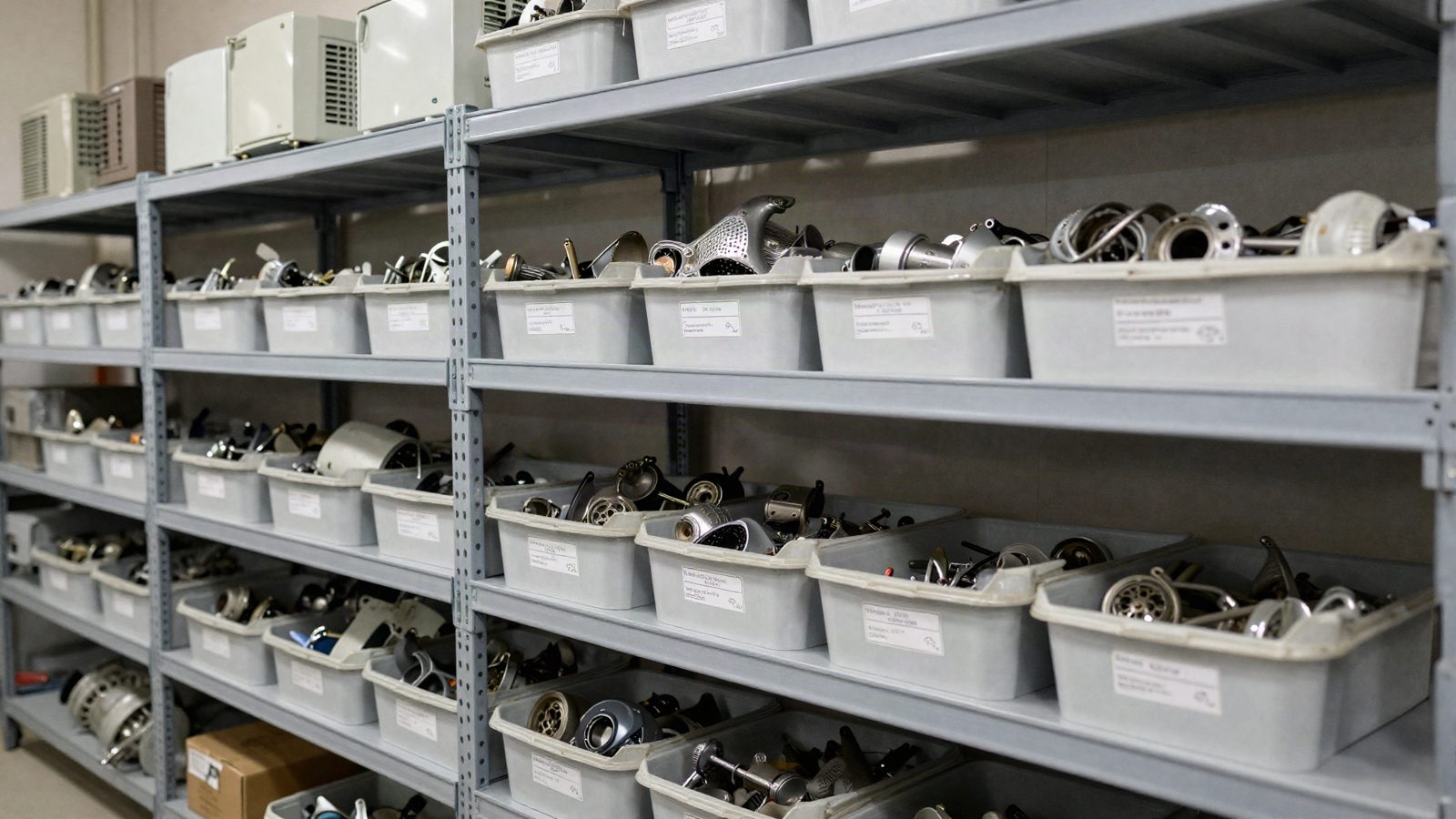
A commercial kitchen repair costs you money on 3 separate days before it earns any: the technician on Friday, the supplier on their terms, and the stock sitting in a van. Growth widens all 3 at once, which is why busy quarters feel tight.
The short version
Service businesses that consume few parts have a simple cash cycle: pay people, invoice, get paid. The gap is labor and it is predictable.
Once commercial equipment is involved you inherit thousands of parts SKUs, and every one of them is money spent before it is money earned. Stock on a shelf, stock in a van, a special-order compressor bought for a job that has not been invoiced yet.
Which produces the characteristic experience of a growing service business: more revenue, more profit on paper, and less money in the bank than last year.
Where the cash actually sits
| Where | What it is | How long |
|---|---|---|
| Van stock | Parts bought and not yet used | Indefinite, and it grows quietly |
| Warehouse stock | The same, in bulk | Indefinite |
| Work in progress | Parts fitted, job not yet invoiced | Days to weeks, and it is fixable |
| Receivables | Invoiced, not paid | Your terms, or theirs |
| Warranty claims | Work done, claim not yet settled | Weeks, and frequently untracked |
Most attention goes to the fourth row. The first three are usually larger combined and almost nobody measures them, because none of them appears as an overdue anything.
Van stock is the number nobody has
And it is cash sitting in vehicles.
Ask a service company what its van stock is worth and the answer is usually an estimate. Ask when it was last counted and the answer is often never, because counting requires the vans to be in and nobody wants them in.
Two things follow. The figure is larger than people think, because van stock accumulates: parts ordered for a job that changed, parts carried for a piece of equipment the customer replaced, parts nobody has needed in two years.
And it is not on any report. A service company with tight cash and no van stock figure is missing one of the two or three largest places its money is.
Roopairs holds parts inventory across vans and a warehouse consumed against work orders, which is what makes that number available rather than an annual surprise.
The 4 levers, in order of how quickly they work
Two are free and two require a conversation.
- Invoice faster. The single fastest cash improvement available and it costs nothing. A service company invoicing three weeks after completion is financing every job for three weeks unnecessarily
- Buy for jobs, not for stock, where you can. A part ordered against a specific job is cash out for days. The same part bought speculatively is cash out until somebody needs it
- Supplier terms. Worth asking for and rarely asked. Suppliers extend terms to reliable payers more often than service companies expect
- Deposits on large parts. On a compressor or a control board, a deposit is normal in adjacent trades and unusual here for no good reason
The first is where most service companies have the most room. Days from work completed to invoice sent is a number worth checking, and paper-based service companies routinely run one to three weeks.
Growth makes it worse before it makes it better
The mechanism worth understanding before it happens.
Adding technicians adds vans, which adds van stock. It adds job volume, which adds work in progress and receivables. And it adds parts purchasing, which adds payables you settle before the invoices land.
All four widen at once, funded from cash generated by a smaller version of the business. That is why a service company can have its best quarter and its tightest month simultaneously.
Which makes the working capital requirement a number to calculate before hiring rather than to discover afterwards. Roughly: what does one additional technician add to stock, work in progress and receivables, and how long before their revenue covers it.
Warranty work is the cash line nobody tracks
Because it does not appear in an aging report.
You pay the technician on Friday and buy the part on your supplier's terms. The manufacturer pays after adjudication, which is weeks, and only if the claim is accepted.
Where claims live in a manufacturer portal rather than in the books, that money is invisible to every cash report you produce. Nobody chases what nobody can see.
The fix is to treat claims as receivables with their own aging: the job, the equipment, the manufacturer, the date submitted, the amount, the status. A service company doing meaningful warranty volume without that has an unmeasured asset and an unmeasured problem.
Portal and chain work stretches the gap deliberately
Not adversarially, structurally.
Chain accounts pay after acceptance rather than after work, and acceptance depends on a closeout being approved and an invoice matching a reference. That adds weeks to a cycle that was already long.
Which means the working capital requirement per dollar of chain revenue is higher than for direct work, and a service company shifting toward chains can find growth and cash pressure arriving together with every job profitable.
Two responses. Model the gap in weeks from work performed to cleared funds rather than from the stated terms. And treat first-time invoice acceptance as a cash metric rather than an administrative one, because a rejected invoice restarts the clock.
What to measure monthly
Four numbers, and only one of them is standard.
Days from work completed to invoice sent. Van and warehouse stock value. Value of completed but uninvoiced work. And warranty claims outstanding by age.
Receivables aging is the one every service company already runs, and it is the one that describes the smallest share of the problem in a parts-heavy business.
Together those four tell you where your cash actually is, and the answer is usually distributed across places nobody was looking rather than concentrated in slow payers.
Where the parts chain and cash meet
The records decision that makes any of this measurable.
Purchase orders created against jobs, parts consumed against equipment, supplier bills matched back to the orders, and payables reaching the books without re-keying.
With that chain intact, stock value, work in progress and parts spend per customer are reports. Without it they are estimates, and cash management on estimates is guessing at the largest numbers in the business.
The pain starts around your third or fourth technician, which is also where the four numbers above stop being interesting and start being the thing that decides whether growth is affordable.
Roopairs runs a product tour where you can see purchase orders, parts inventory and job costing in one place.
What service companies in the trade say
“Loving the software so far. Running a commercial refrigeration company with a small residential hvac client base.” — Aaron Anderson
Also worth reading
- Technician Productivity: What Moves It
- Financing Growth in a Service Business
- Service software built to manage purchase orders and inventory
Frequently asked questions
Why is cash tight in a parts-heavy service business?
Because every job costs money on three days before it earns any: the technician's wage, the supplier's terms, and the stock sitting in vans. All three widen as the business grows, funded from a smaller version of it.
Where is the cash actually sitting?
Van stock, warehouse stock, completed but uninvoiced work, receivables, and unsettled warranty claims. Most attention goes to receivables, and the first three combined are usually larger and unmeasured.
What is the fastest improvement?
Invoicing faster. It costs nothing and a service company invoicing three weeks after completion is financing every job for three weeks unnecessarily. Check days from work completed to invoice sent.
Why does van stock matter so much?
Because it accumulates and it is rarely counted. Parts ordered for jobs that changed, parts for equipment the customer replaced, parts nobody has needed in two years. It is cash sitting in vehicles and it appears on no report.
Why does warranty work strain cash?
Labor is paid on Friday, parts on supplier terms, and the manufacturer pays after adjudication only if the claim is accepted. Where claims live in a portal rather than the books, that money is invisible to every cash report.
What should be measured monthly?
Days from completion to invoice, stock value across vans and warehouse, the value of completed but uninvoiced work, and warranty claims by age. Receivables aging is the standard one and it describes the smallest share of the problem.
See how Roopairs can help your service business scale
The all-in-one platform built for commercial kitchen service companies. Dispatch, invoicing, parts ordering — all in one place.
Book a product tour →