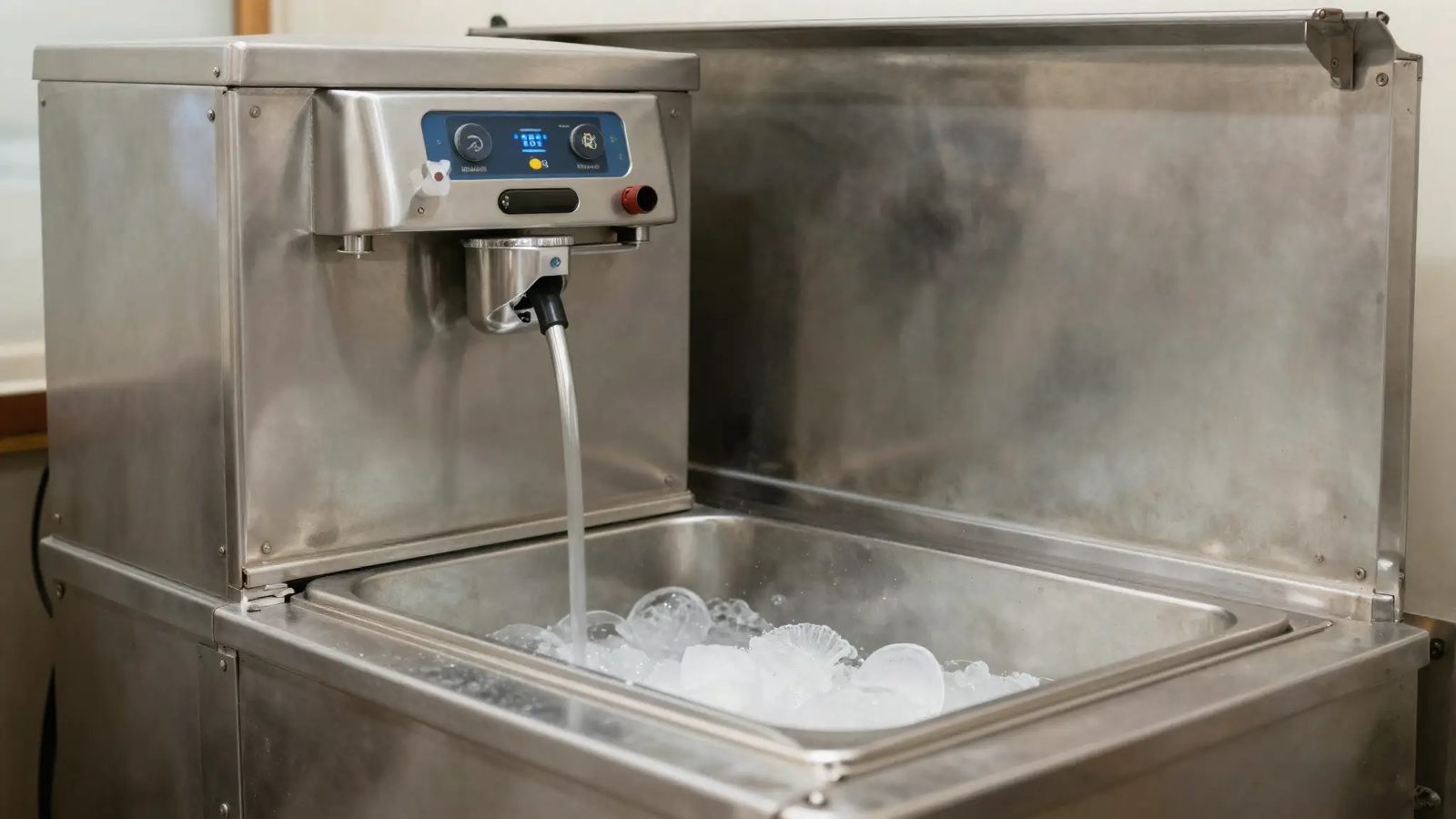
Most commercial ice machine failures start in the water, not the refrigeration circuit. Manufacturers put the baseline service interval at 6 months for descaling, sanitizing and a filter change, and hard water shortens it. Scale on the ice thickness sensor alone changes freeze and harvest times.
The short version
An ice machine is the one piece of kitchen equipment that is a water treatment problem wearing a refrigeration coat. Everything the water carries stays behind when the ice leaves.
Scotsman, Manitowoc and Follett all land on the same baseline: descale, sanitize and change the filter at least every 6 months, and shorten that where the water is hard or high in dissolved solids. Follett's own control lets the reminder be set from 1 to 6 months for exactly that reason.
Which gives the service company a straightforward rule. The interval is not a number you inherit from the last provider. It is a number you set from the water at that site.
Why water decides the service interval
Minerals in the supply do not freeze into the cubes. They concentrate in the water that is left behind, and they plate out on every surface the water touches on the way.
Three of those surfaces matter more than the rest.
- The evaporator: scale insulates the plate, so the same refrigeration effect takes longer to make the same ice
- The ice thickness sensor: scale changes what it reads, which changes when the harvest starts
- The water distributor and trough: uneven flow produces uneven cubes and short freeze cycles
Scotsman's own maintenance guidance makes the sensor point explicitly: mineral buildup left in place changes the ice bridge thickness, and the scale has to come off the sensor to correct it.
That is why a call logged as "makes less ice" is usually a water call. The refrigeration side is fine and the heat is simply not getting through the deposit.
The 4 faults a technician sees most
| What the kitchen reports | What it usually is | What to check first |
|---|---|---|
| Production has dropped | Scale on the evaporator, or a restricted water supply | Filter age, inlet pressure, visible deposit on the plate |
| Cubes are cloudy, small or hollow | Uneven water flow across the evaporator | Distributor holes, trough level, purge valve |
| Harvest takes too long, or sheets stick | Sensor reading off because of scale, harvest assist faults | Ice thickness sensor, hot gas valve operation |
| The unit shuts down in the afternoon | High discharge pressure | Condenser cleanliness, ambient temperature, airflow, fan motor |
The fourth row is the one that produces an argument with the customer. An ice machine in a hot back corridor with no clearance will fail in July and work perfectly in October, and nothing on the unit is broken.
What a proper service visit covers
A descale that skips the sanitize leaves the biological half of the problem in place, and manufacturers treat the two as one job. Scotsman says to sanitize the water system whenever scale has been removed.
- Descale the water system, including trough, distributor and evaporator
- Sanitize after descaling, every time
- Change the water filter and note the date on the record
- Clean the ice thickness sensor and verify bridge thickness afterwards
- Clean the condenser, air cooled or remote, on the same 6 month rhythm
- Check the bin, the door seal and the drain, since warm bins melt what the unit just made
Manitowoc adds the step most service companies skip: if a unit needs descaling more often than the baseline, test the water rather than shorten the interval forever. The answer is usually treatment at the inlet, which is a one time cost against a recurring one.
Setting the interval per site instead of per customer
Two restaurants on the same street can need different intervals, because the water supply, the ambient conditions and the duty cycle differ. A customer-level schedule cannot express that. An equipment-level one can.
What the record needs to carry, per unit rather than per address:
- Model and serial, because filter and descale procedures differ by family
- Last descale, last sanitize, last filter change, each with its date
- Water test results if one was taken, and the treatment fitted
- Production observed at service, which is the number that shows drift between visits
- Location notes: ambient, clearance, condenser type
A service company holding those 5 things can defend an interval to a customer who thinks twice a year is twice too often. Without them, the conversation is an opinion against an invoice.
Roopairs runs a product tour where you can see equipment records, maintenance schedules held on the asset and service history in one place.
What the operator should be told
Three sentences prevent most emergency calls, and they are worth saying at every visit.
Ice production falls in summer because the room is hotter, so keep the clearance around the unit free. A filter is not optional equipment, it is the cheapest part on the unit. And ice that tastes of the kitchen is a sanitation finding, not a refrigeration one.
What service companies in the trade say
“App is very well laid out and very easy to use. I definitely appreciate the simplicity to using the app, but the fact that it also provides so much functionality.” — Mikah Levitt-Freimuth
Also worth reading
- Commercial Refrigeration Maintenance Contracts
- EPA 608 and Refrigerant Handling
- Refrigeration Service Management Software
Frequently asked questions
How often should a commercial ice machine be serviced?
Manufacturers put the baseline at every 6 months for descaling, sanitizing and a filter change. Scotsman, Manitowoc and Follett all state that interval, and all three say to shorten it where water is hard or high in dissolved solids. Follett's control allows a reminder from 1 to 6 months.
Why is the ice machine making less ice?
Usually scale on the evaporator or a restricted water supply rather than a refrigeration fault. Scale insulates the plate, so the same cooling makes less ice in the same time. Check filter age and inlet flow before reaching for gauges.
What causes long harvest times?
Scale on the ice thickness sensor is a common cause, because it changes what the control reads and therefore when harvest begins. Scotsman's guidance is explicit that buildup changes the ice bridge thickness and the sensor has to be cleaned to correct it.
Does a water filter prevent scale?
A filter reduces what reaches the unit and does not change water hardness on its own. Where descaling is needed more often than the baseline, manufacturers recommend testing the water and fitting appropriate treatment rather than simply servicing more often.
Why does the unit cut out on hot afternoons?
High discharge pressure, usually from a dirty condenser, poor ventilation, high ambient temperature or a failed fan motor. The unit is protecting itself. Clearance around the equipment and a condenser cleaned on the same 6 month rhythm prevent most of these calls.
Is sanitizing really needed every time?
Yes, and manufacturers tie it to descaling rather than treating it as a separate job. Ice equipment is prone to biological growth as well as mineral buildup, so removing scale without sanitizing addresses half the problem and leaves the half the customer can taste.
See how Roopairs can help your service business scale
The all-in-one platform built for commercial kitchen service companies. Dispatch, invoicing, parts ordering — all in one place.
Book a product tour →