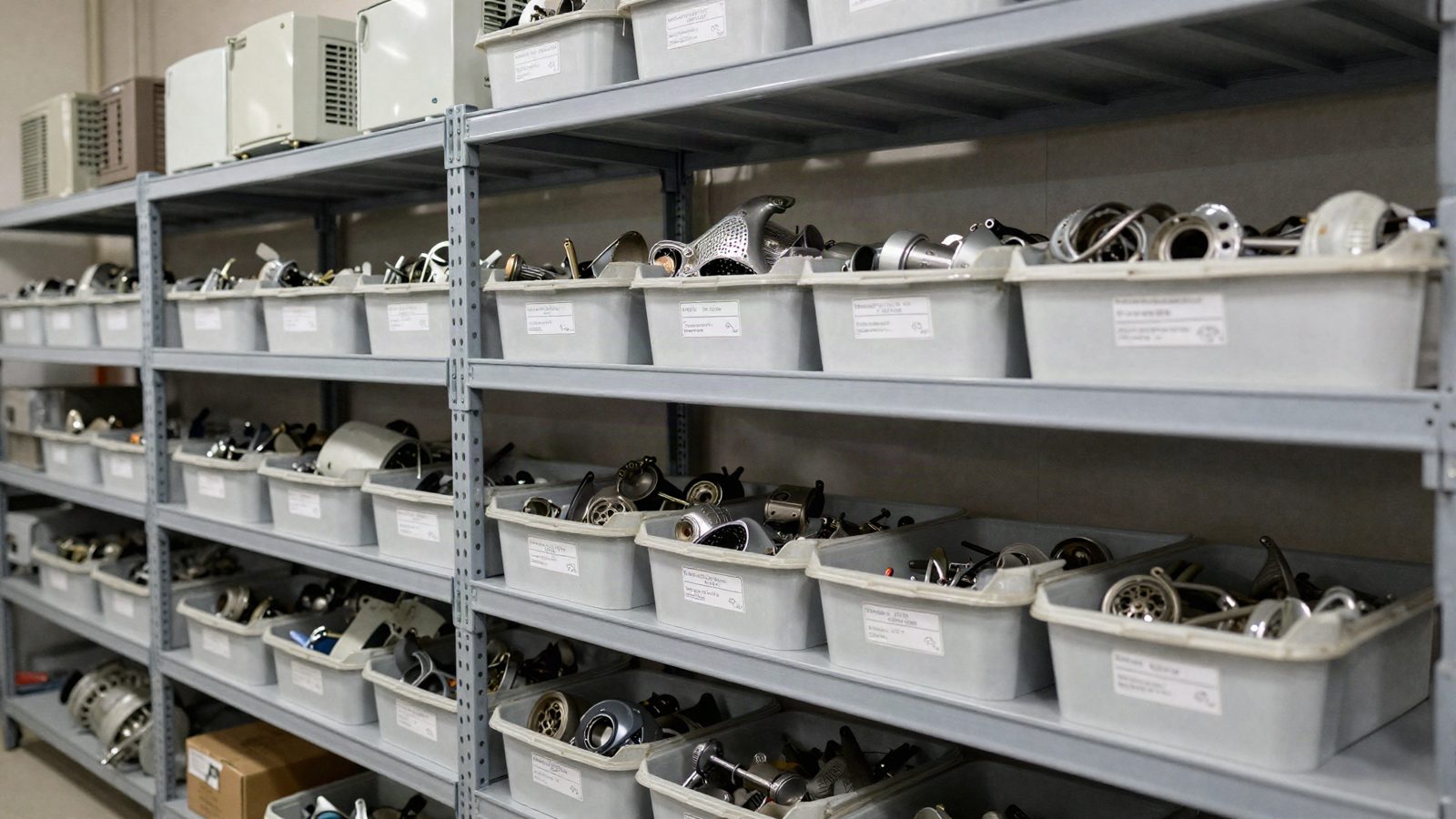
"Restaurant inventory management software" returns 2 different categories. One tracks food: cases of chicken, par levels, waste, food cost percentage. The other tracks the parts that fix the equipment: contactors, gaskets, compressors, purchase orders. Which you need depends on whether you run the kitchen or repair it.
The short version
- Food inventory software is built for operators and answers "what did we use and what did it cost".
- Parts inventory software is built for service companies and answers "do we have the part, and did it reach the invoice".
- They share a word and almost nothing else. The unit, the cycle, the vocabulary and the buyer are all different.
- A restaurant group usually needs the first. Their equipment service provider needs the second.
- Buying the wrong one is a slow discovery, because both work fine until the specific thing you needed is missing.
Why one search term returns two categories
Search for restaurant inventory management software and page one is dominated by food inventory products, plus a Reddit thread of operators comparing them. That is the correct result for the majority of people typing it, because most of them run restaurants.
The minority typing it are the companies that service those restaurants' equipment, and they mean something else entirely. Their inventory is not food. It is the parts room, the van stock, and the purchase orders that keep both supplied.
Search engines have no way to tell those two readers apart from four words, so both end up on the same page. This article exists to sort them.
The two categories, side by side
| Food inventory software | Parts inventory software | |
|---|---|---|
| Who buys it | Restaurant operator, chef, multi-unit F&B director | Owner or operations manager at an equipment service company |
| What it counts | Ingredients, cases, portions, par levels | Part numbers, assemblies, serialized components |
| The core question | What did we use, what did it cost, and what did we waste? | Do we have it, where is it, and did it reach the invoice? |
| Where stock lives | Walk-in, dry store, prep line. Fixed locations. | Warehouse shelf and every van. Locations that move daily. |
| Cycle | Daily to weekly. Perishable. | Weeks to years. A control board can sit for eight months. |
| Attaches to | A recipe, a menu item, a period | A work order and a specific piece of equipment |
| Buying process | Standing orders with food distributors | Purchase orders to parts suppliers, often per job |
| Failure mode | Food cost drifts and nobody knows why | Technician arrives without the part, or the part never reaches the invoice |
What food inventory software is for
An operator's inventory problem is cost and waste. Product arrives, gets prepped, gets sold or gets thrown away, and the software's job is to connect what was bought to what was sold so that food cost percentage means something.
The measurements that matter are theoretical against actual usage, par levels, and variance by item. The cycle is short because the product spoils, so counts happen weekly or daily and the software is built around that rhythm.
If that describes your problem, this is the category you want and the products on page one of that search are the right shortlist.
What parts inventory software is for
A service company's inventory problem is availability and attribution. Did the technician have the part, and did the cost of that part reach the job so the invoice is right and the margin is visible.
The unit is a part number, sometimes a serial number. The location is either the warehouse or one of six vans, and the van is usually somewhere else. The cycle is measured in months, and the expensive items are the ones that move least.
The workflow that food inventory software has no reason to include is the purchase order: the document that says a part was ordered for a reason, at a price, against a job, and that lets the supplier's bill be checked when it arrives rather than simply paid.
Why this is a gap rather than an oversight
Purchase orders, parts inventory management, equipment asset tracking and accounts payable are among the biggest components of a field service platform that products built for other markets do not have. That is not a flaw in food inventory software. It would be strange for a product that tracks chicken to create a purchase order against a compressor.
The same logic applies to field service products built for residential trades. A homeowner job does not carry a parts chain, so the requirement never existed. Once commercial equipment is involved you inherit thousands of part numbers and the workflows around them, and the pain starts around your third or fourth technician.
Which one do you need?
Three questions settle it.
- Does your inventory spoil? If yes, food inventory software.
- Does a unit of your inventory get fitted to a specific piece of equipment? If yes, parts inventory, and you also need equipment records so the history follows the equipment rather than the address.
- Does somebody bill a customer for the item you consumed? If yes, the inventory has to connect to a work order and an invoice, which is a parts inventory requirement and not a food one.
The case where you need both
A restaurant group large enough to run its own in-house maintenance team genuinely needs both, and they do not merge. The food side sits with operations, the parts side sits with facilities, and they answer to different people on different cycles. Trying to make one product do both usually produces a system that neither team trusts.
What to ask a vendor before you commit
If you are a service company and a vendor tells you their product handles inventory, four questions will tell you which category you are actually looking at.
- Can stock be held against a vehicle? If inventory only exists in one warehouse location, van stock will live in a spreadsheet.
- Can I create a purchase order from a job? Not a purchase order module. From the job that needs the part.
- Does a part consumed on a work order come off stock automatically? If it is a separate step, it is a step that gets skipped at 5pm.
- Does the part reach the invoice and the job cost? This is where the money is. A part fitted and not billed is margin that left the building.
Roopairs holds parts inventory, purchase orders and the equipment record in the same place as the work order, which is what makes the last two answers straightforward rather than a workaround.
If you landed here looking for food inventory
You are in the wrong place, and the products on that search result are the right ones for you. The useful thing to take from this page is the vocabulary: when your equipment service provider talks about inventory, they mean parts, and when they say a job is waiting on stock, they mean a component and not a delivery of produce.
If you service commercial kitchen equipment, see how the parts side works, or read what Roopairs covers.
What service companies in the trade say
“The software allows me to input jobs, keep track of parts, and easily bill customers, helping me streamline my workflow and save time.” — Daniel Argueta
Also worth reading
- Restaurant Software: Which One Fits a Service Firm
- Inventory Management CRM: Two Different Products
- Service software built to manage purchase orders and inventory
Frequently asked questions
What is the best software for managing food inventory in restaurants?
That is a different category from the one this article covers, and the products ranking for that search are built for it. The short version: look for recipe-level costing, par levels, variance reporting between theoretical and actual usage, and an integration with whichever point of sale you already run.
What is the best inventory app for restaurants?
Again, depends which inventory. For food, the products on that search result. For the parts that keep the equipment running, you are looking at field service software with parts inventory built in, which is a much smaller set of products with a different buyer.
Is there any free software for managing restaurant inventory?
Free tools exist on the food side, usually spreadsheet templates or limited tiers of paid products. On the parts side, free generally means a spreadsheet, which works until the parts are on more than two vans and then stops working quietly rather than obviously.
Can one system handle both food and parts?
In principle yes, in practice rarely well. The two have different units, cycles, buyers and reporting needs, and a product that covers both usually does one properly. Most operations that need both run two systems and are happier for it.
What is the best HVAC inventory management software?
This is the parts side of the question, asked by a different trade. The requirements are the same as for commercial kitchen work: stock held per vehicle, purchase orders created from a job, automatic consumption against a work order, and the cost reaching the invoice. The difference is which parts you carry, not how the system needs to behave.
How do I know if my current software is doing parts inventory properly?
Pick a job from last month where a part was fitted. Trace it backwards: from the invoice to the work order, to the stock movement, to the purchase order, to the supplier's bill. If any of those steps requires opening a spreadsheet or asking someone, that is the gap.
See how Roopairs can help your service business scale
The all-in-one platform built for commercial kitchen service companies. Dispatch, invoicing, parts ordering — all in one place.
Book a product tour →