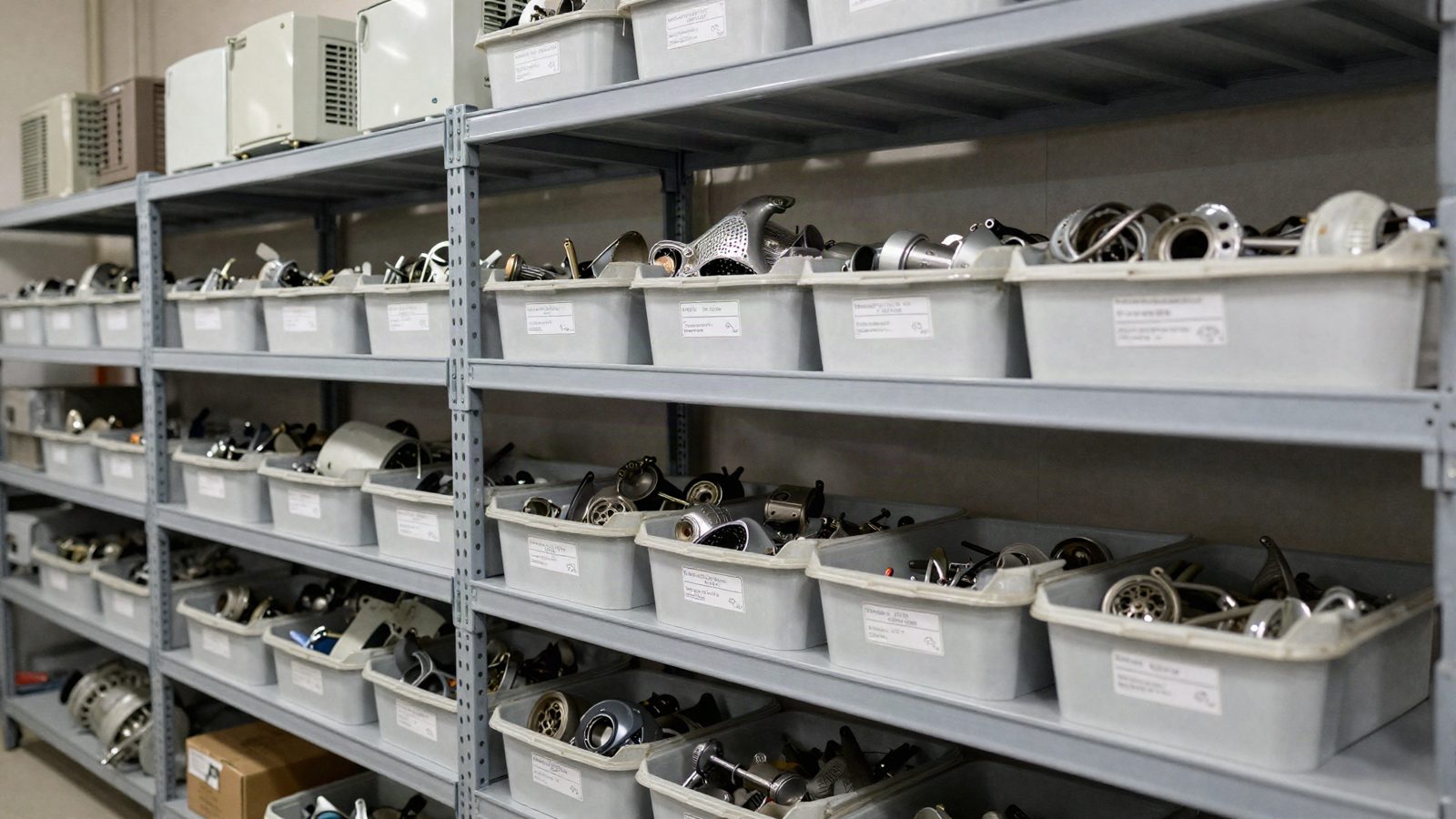
This is 1 decision, not 2 systems. Whichever place holds the quantities is your system of record and the other one receives the result. Service companies that decide neither end up maintaining both, and the two disagree within a month because parts move in the field and get recorded in the office.
The short version
The question sounds like a comparison and it is a governance decision. There is no arrangement where both systems own the count, because a count has to have one owner.
What decides it is where the movements happen:
- Parts move where the work is. Onto a van, into a piece of equipment, back to a supplier. Those events happen in the field
- Value and tax reporting happen in the office. Those events happen monthly and in the books
- The system that records movements as they occur should hold the count. The other receives totals
For a commercial service business that usually means the field service software holds the count and the accounting system receives the value. What matters more than which way round is that it is decided rather than defaulted into.
What each side is genuinely good at
Both are competent and they were built for different questions.
| Accounting system | Field service software | |
|---|---|---|
| Built to answer | What is this stock worth and what did it cost | Where is this part and which job consumed it |
| Locations | Usually one, sometimes a few warehouses | The service company and a van per technician |
| Who records movements | The office, from paperwork | The technician, at the point of use |
| Job costing | By account or class, not usually by work order | By work order, if parts attach to jobs |
| Valuation and tax | Its purpose | Rarely, and it should not try |
The row that decides most cases is who records movements. A part fitted at 4pm in a kitchen forty minutes away is recorded by the technician or it is recorded from a note two days later. Systems that depend on the second are describing yesterday.
Why maintaining both is the expensive answer
Nobody chooses this and plenty of service companies are in it. It happens by accumulation: inventory was set up in the accounting system years ago, field service software arrived later with its own inventory, and neither was switched off.
What follows is predictable. The technician records a part used in the field software and nobody mirrors it in accounting.
The month-end count then comes from accounting, which is wrong. Somebody adjusts one side to match the other, which destroys the audit trail on both.
The cost is not the reconciliation time, though that is real. It is that nobody trusts either number, so the count stops being used for decisions and becomes a formality performed once a year.
The fix is a decision rather than a project: name the system of record, turn the other one off for quantities, and let it receive totals instead.
3 questions decide this without a spreadsheet
These settle it for most service companies without a spreadsheet.
- Do parts move in the field? If technicians carry stock and consume it on site, the field software should hold the count. If everything is picked at the warehouse by one person, accounting can.
- Do you need job-level parts cost? If yes, the count has to live where jobs live, because otherwise attaching a part to a work order is a manual step that will not survive a busy week.
- Who does the counting? The system of record should be the one the counters use. Asking a technician to count into an accounting system is how counts stop happening.
Two yes answers point clearly at the field software. Three no answers point at accounting, and that is a legitimate outcome for a service company with one stockroom and no van stock.
What has to cross, and in which direction
Once the system of record is named, the integration has a job description.
From the field software to accounting: the value of parts consumed, the cost landing on jobs, purchase orders becoming vendor bills, and the total value of stock on hand at period end. That is what the books need and it is a summary rather than every movement.
From accounting to the field software: usually very little. Vendor records and sometimes a pricebook.
What should never cross in both directions is quantity. Two systems both writing quantities is the same as having no system of record, whatever the integration promises.
Roopairs describes its QuickBooks connection as an integration sync rather than an export, working with Online or Desktop, and covering vendors, bills, credit notes and the journal entries behind them. What actually crosses between a field platform and QuickBooks, and how sync differs from export, is worth reading separately before you evaluate any integration.
When your accountant wants inventory in the books
This is the most common objection and it is usually a misunderstanding about what is being moved.
An accountant asking for inventory in the accounting system is asking for the value on the balance sheet and the cost of goods figure. Both are satisfied by receiving totals from the field software. Neither requires the accounting system to hold the quantities.
The conversation that works is narrow. Ask what they need at period end: closing stock value, cost of parts consumed, and a way to check it. Then confirm the field software can produce all three. Almost always it can, and the objection dissolves once it is about outputs rather than about where a number is typed.
Where the objection is legitimate is auditability. If somebody can change a quantity in the field software with no trail, an accountant is right to be uneasy. That is a question to ask a vendor directly rather than a reason to keep two counts.
QuickBooks Desktop is still here, and it changes the answer
Plenty of commercial service businesses run Desktop, often with an inventory setup that has been in place for years and works.
Two things follow. Desktop has real inventory capability, so the accounting-as-system-of-record option is more viable than it would be elsewhere. And integrations to Desktop differ from Online, so support has to be confirmed rather than assumed for the specific edition you run.
Where service companies go wrong is treating the existing Desktop setup as a reason not to decide. An inventory module that works for valuation is not evidence that it should hold van stock, and the two questions get answered together when they are separate.
A physical count on 1 date is how the switch works
If you are moving the system of record, the migration is mostly discipline rather than data.
Pick a date, count everything the day before, and start from that count in the new system rather than importing a number nobody trusts. A migration that carries forward a wrong count produces a system that was wrong from day one and gets blamed for it.
Then run one period with the old system in read-only mode so the first month end has something to compare against. Expect a gap and expect it to be mostly the old number rather than the new one.
Turning the old quantities off matters more than any of it. Leaving them on as a backup is how service companies end up maintaining both, which is where this started.
Roopairs runs a product tour where you can see parts, purchase orders and jobs in one place and what reaches the accounting side.
What service companies in the trade say
“One feature that stands out to me is the ability to track spending on each piece of equipment for my customers.” — Martin Turner
Also worth reading
- Reading Field Service Software Reviews for This Trade
- QuickBooks and Field Service Software: What Syncs
- Service software built to manage purchase orders and inventory
Frequently asked questions
Should parts inventory be in QuickBooks or field service software?
Wherever the movements are recorded. If technicians carry stock and consume it on site, the field service software should hold the count and the accounting system should receive value. If all parts are picked at the warehouse by one person, accounting can hold it. What does not work is both.
Can QuickBooks handle inventory for a service business?
It handles quantities and valuation, which is most of what an accountant needs. What it is not built for is multiple field locations and attaching a part to a work order. Those two are the reason service businesses move the count elsewhere as they grow.
What happens if both systems track inventory?
They disagree, usually within weeks, because parts move in the field and get recorded in the office. Then somebody adjusts one to match the other, which removes the audit trail from both, and after a while nobody uses either number for a decision.
Does the integration solve it?
Not on its own. An integration moves data between two systems and does not decide which one is authoritative. Quantities crossing in both directions is the specific arrangement to avoid, and it is worth asking a vendor directly which way quantity flows.
What about QuickBooks Desktop?
Desktop has genuine inventory capability, which makes the accounting-as-record option more realistic than it might otherwise be. Confirm that any field service product supports the edition you run rather than assuming, since Online and Desktop integrations are not the same thing.
How do we switch without losing our numbers?
Count physically on a chosen date and start the new system from that count rather than importing an old one. Keep the previous system readable for one full period so the first month end has a comparison, then turn its quantities off. Leaving them on is how service companies end up running both.
See how Roopairs can help your service business scale
The all-in-one platform built for commercial kitchen service companies. Dispatch, invoicing, parts ordering — all in one place.
Book a product tour →