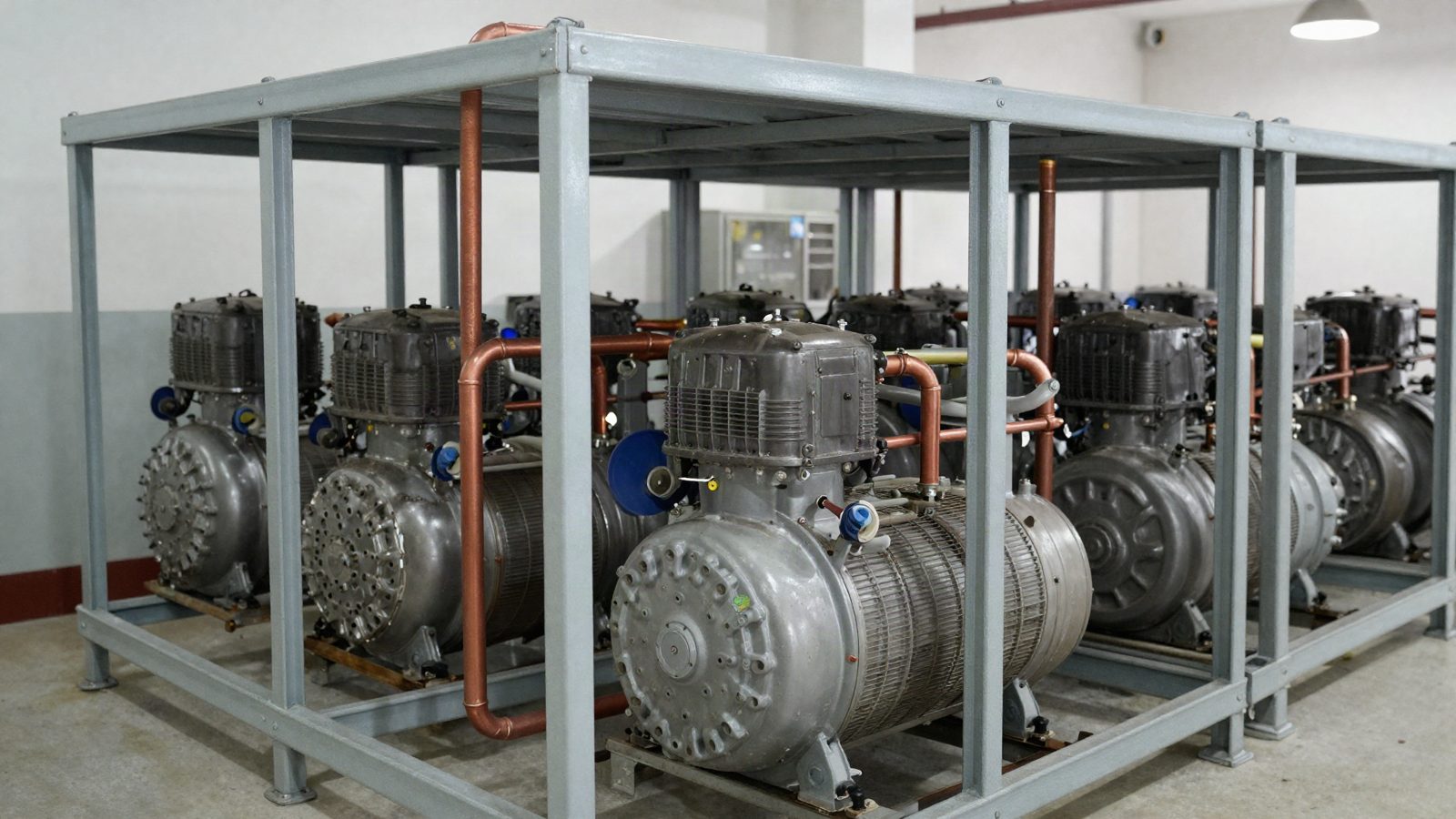
Most commercial HVAC systems a service company meets fall into 5 types: single-zone split systems, packaged rooftop units, multi-split and VRF systems, chilled water plants with air handlers, and the makeup air and exhaust equipment on restaurant roofs. Each type fails in different places and asks for different skills, truck stock, visit length and records.
Key takeaways
- Packaged rooftop units carry most of the work in restaurants, retail and low-rise offices, and most of their failures are stockable parts.
- VRF shifts the work from wrenching to diagnosis, with brand-specific parts ordered per job.
- Chilled water plants mean longer visits, more labor than parts, and logs read as a series.
- Makeup air and kitchen exhaust are part of every restaurant account, even when another trade cleans the hood.
- The record that pays off is per unit, not per address: manufacturer, model, serial number and service history.
What are the main types of commercial HVAC systems?
The five types below cover most commercial buildings a 5 to 20 technician service company is called to. A hotel or a school can run three of them on one site, and a dispatcher reading "no cooling, suite 4" needs to know which one is behind the complaint.
| System type | Typical buildings | Where it usually fails | What it asks of the service company |
|---|---|---|---|
| Single-zone split system | Small offices, server rooms, dining rooms, tenant suites | Capacitors, contactors, condensate drains, dirty coils | Short visits, common parts on the truck, two locations per unit to reach |
| Packaged rooftop unit | Restaurants, retail, strip centers, low-rise offices, schools | Belts, filters, igniters, flame sensors, inducer motors, economizers | Roof access, many units per site, filter and belt sizes per unit |
| Multi-split and VRF | Hotels, offices, mixed-use, renovated older buildings | Communication faults, sensors, electronic expansion valves, inverter boards, leaks | Brand training, diagnostic tools, parts ordered per job |
| Chilled water with air handlers | Larger offices, hotels, hospitals, campuses | Pumps, cooling tower water, control valves, VFDs, air handler belts and bearings | Longer visits, more labor than parts, run logs kept as a series |
| Makeup air and kitchen exhaust | Restaurants, hotel kitchens, school cafeterias | Belts, motor bearings, burners, interlocks, grease on fans | Coordination with the hood and fire suppression trades, service around kitchen hours |
Many HVAC/R service companies also run walk-ins and reach-ins on the same accounts. That side is covered in our guide on how commercial refrigeration systems in a restaurant work.
How does a single-zone split system fail, and what does it ask of a tech?
A split system fails mostly at the outdoor electrical parts and the indoor condensate side, which makes it the simplest of the five to stock for. One condensing unit outside serves one indoor unit, either a ducted air handler or a ductless wall or ceiling cassette.
Components
Outdoor: compressor, condenser coil, condenser fan motor, contactor, run capacitor. Indoor: evaporator coil, blower motor, metering device, condensate pan and drain, often a condensate pump on ductless units. Between them: the refrigerant line set and the control wiring.
What it means for the service company
Visits are short, and a tech with capacitors, contactors, a condensate pump and coil cleaner on the van closes most calls on the first trip. The catch is that one unit lives in two places, the condensing unit on the roof and the indoor unit above a ceiling grid. A work order that only names the suite sends the tech hunting.
Why are packaged rooftop units the core of commercial HVAC service?
Rooftop units put the whole system in one cabinet on the roof, and they serve a large share of the restaurants, retail and low-rise buildings a commercial HVAC service company works in.
Components
Compressor, condenser coil and fans, evaporator coil, supply blower (belt or direct drive), filters and a heat section: gas (heat exchanger, inducer motor, gas valve, igniter, flame sensor), electric strips or a heat pump. Many units add an economizer with dampers, an actuator and sensors.
Where rooftop units fail
Most failures are wear parts: a glazed belt, a loaded filter that freezes the coil, a dirty flame sensor, a weak igniter, inducer motor bearings, a burned contactor, a failed capacitor. A stuck economizer actuator is quieter and costs the customer energy for months without anyone calling.
Compressor failures are rarer and much larger: a recovery, a part ordered from a supplier, often a crane.
What it means for the service company
Rooftop work rewards a well-kept unit list. If the record says unit 3 takes a particular belt and four filters of a particular size, the tech arrives with them. If it says nothing, the first visit is a measuring trip.
Visit length depends more on access than on the unit. Roof hatch or ladder, roof work only before opening, a key held by the manager: that belongs on the location record.
What changes when a building runs VRF or multi-split?
VRF moves the work from replacing wear parts to reading the system, because one outdoor unit feeds many indoor units through long piping and a communication network. Heat recovery versions let some zones heat while others cool.
Components
Outdoor unit with inverter compressor and board, indoor units (ducted, cassette or wall), branch selector boxes on heat recovery systems, electronic expansion valves, sensors, communication wiring and a central controller.
Where VRF fails
Communication faults, failed sensors, sticking expansion valves and inverter board failures make up much of the call volume. Leaks are slow to find in long piping with many brazed joints.
What it means for the service company
Manufacturers commonly tie commissioning and warranty work to their own training, so it matters which tech is trained on which brand. Parts are brand-specific and usually ordered per job rather than carried, which turns a VRF repair into a two-visit job with a purchase order in the middle. Each indoor unit is its own asset with its own address on the system, and a record that lists only "VRF system, 3rd floor" cannot tell the next tech that the cassette in room 312 has thrown the same fault three times.
How do chilled water systems differ for a service company?
Chilled water systems are plants rather than units, and service on them is mostly labor, logs and coordination with the building's own engineers. A chiller cools water, pumps move it to air handlers, and a cooling tower rejects the heat on water-cooled plants.
Components
Chiller, cooling tower with water treatment, chilled and condenser water pumps, air handlers with chilled water coils, control valves and actuators, VFDs, VAV boxes and a building automation system.
Where chilled water systems fail
Pump seals and bearings, VFD faults, unresponsive control valves, air handler belts and bearings, stuck VAV dampers, and condenser tubes fouled by poor tower water.
What it means for the service company
Visits run longer and the parts bill is small relative to the labor. Large chillers that use low-pressure refrigerant need technicians certified for that equipment type. Some service companies run the air side, pumps and towers themselves and bring in a specialist for chiller teardowns. The value of the account sits in the logs: pressures, temperatures and amps recorded the same way every visit.
Why do makeup air and kitchen exhaust belong in a restaurant HVAC account?
A restaurant kitchen pulls large volumes of air out through the hood, and the makeup air unit has to put that air back, so the two pieces of equipment work as one system. Out of balance, the front doors get hard to open and the kitchen fills with smoke.
Components
Upblast exhaust fan on the roof, the makeup air unit (blower, belt, filters, often a gas burner with flame safeguard), and an interlock that starts makeup air when the exhaust runs.
Where they fail
Belts and bearings on both fans, grease on the exhaust fan wheel, burner and flame safeguard faults, clogged filters, and interlocks bypassed during a remodel.
What it means for the service company
This equipment sits between three trades: hood cleaning degreases the duct and fan, fire suppression services the system over the line, and the HVAC tech keeps the fans running. Belt changes happen before prep or after close. Many HVAC service companies quote makeup air and exhaust into their restaurant PM contracts.
Which commercial HVAC system components show up in every type?
Six component groups repeat across all five systems, and they are the backbone of any truck stock list. The brand and size change, the category does not.
- Electrical: contactors, capacitors, relays, fuses, transformers
- Air movement: blower and fan motors, belts, pulleys, bearings
- Filtration: filters in the sizes your customers' units actually take
- Refrigerant circuit: compressors, coils, metering devices, driers
- Heat: igniters, flame sensors, gas valves, inducer motors, heat strips
- Controls and condensate: thermostats, sensors, actuators, condensate pumps and switches
Stock should follow the equipment you service. A contract base of restaurant rooftop units needs deep belts, filters and ignition parts. Hotel VRF needs fewer parts on the van and a fast path from diagnosis to purchase order.
What should the equipment record hold for each type?
The record should follow the unit: manufacturer, model and serial number off the nameplate first, then the details that differ by type.
- Split systems: where both halves are, and which indoor unit pairs with which outdoor unit
- Rooftop units: unit number, belt size, filter size and count, heat type
- VRF: each indoor unit as its own asset linked to its outdoor unit
- Chilled water: readings logged as fields rather than notes, tube cleaning dates
- Makeup air and exhaust: belt sizes for both fans and which exhaust fan pairs with which makeup air unit
Roopairs is built as an AI service platform for commercial kitchen and HVACR work, and the equipment record is where it starts. It tracks manufacturer, model, serial, service history, location history and warranty agreements with partner manufacturers, and keeps planned maintenance contracts against the equipment. Purchase orders attach to work orders, which matters on a VRF job where the part is ordered between visits.
Multi-site customers add one more layer. Chains often send work through a facilities management portal such as ServiceChannel, Corrigo or Ecotrak, naming a location rather than a unit. Our guide to working inside ServiceChannel, Ecotrak and Corrigo covers how service companies handle that.
Roopairs runs a product tour where you can see equipment records, planned maintenance contracts, dispatch and purchase orders in one place.
What service companies in the trade say
“As a new business owner, this platform has been a big part of helping my company grow and manage my business in one place with ease. From service calls to installation jobs Roopairs has it covered!” — Summit Mechanical (UT)
Also worth reading
- Commercial HVAC Field Service Software: How to Choose
- Commercial Refrigeration: How the Systems in a Restaurant Work
Frequently asked questions
What is the most common commercial HVAC system?
In restaurants, retail and low-rise commercial buildings, the packaged rooftop unit. Larger buildings such as hospitals and big office towers more often run chilled water plants with air handlers.
What is the difference between commercial and residential HVAC systems?
Scale and count. Commercial equipment is larger, often on the roof, and one site can carry many units serving different tenants, which changes access, scheduling and record keeping.
Is VRF harder to service than a rooftop unit?
It asks for different skills. Rooftop work is mostly wear parts a tech can carry. VRF work is mostly diagnosis through fault codes and manufacturer tools, so first-visit fixes depend more on training than on truck stock.
Do HVAC technicians service kitchen exhaust fans?
Usually yes, for the mechanical side: belts, motors, bearings and the interlock with the makeup air unit. Degreasing the duct and fan typically belongs to a hood cleaning company, and the fire suppression system to a licensed fire suppression vendor.
Which commercial HVAC parts should be on every truck?
Contactors, capacitors, common belts, filters in the sizes your customers use, igniters, flame sensors, a universal condenser fan motor, condensate pumps and coil cleaner. Depth should come from your unit records.
Why track commercial HVAC equipment by serial number?
Because parts lookups, warranty status and failure history all hang off the individual unit. A record kept by address cannot show that one rooftop unit out of six has had the same inducer motor replaced twice, and that pattern is what tells you to quote a replacement.
See how Roopairs can help your service business scale
The all-in-one platform built for commercial kitchen service companies. Dispatch, invoicing, parts ordering — all in one place.
Book a product tour →