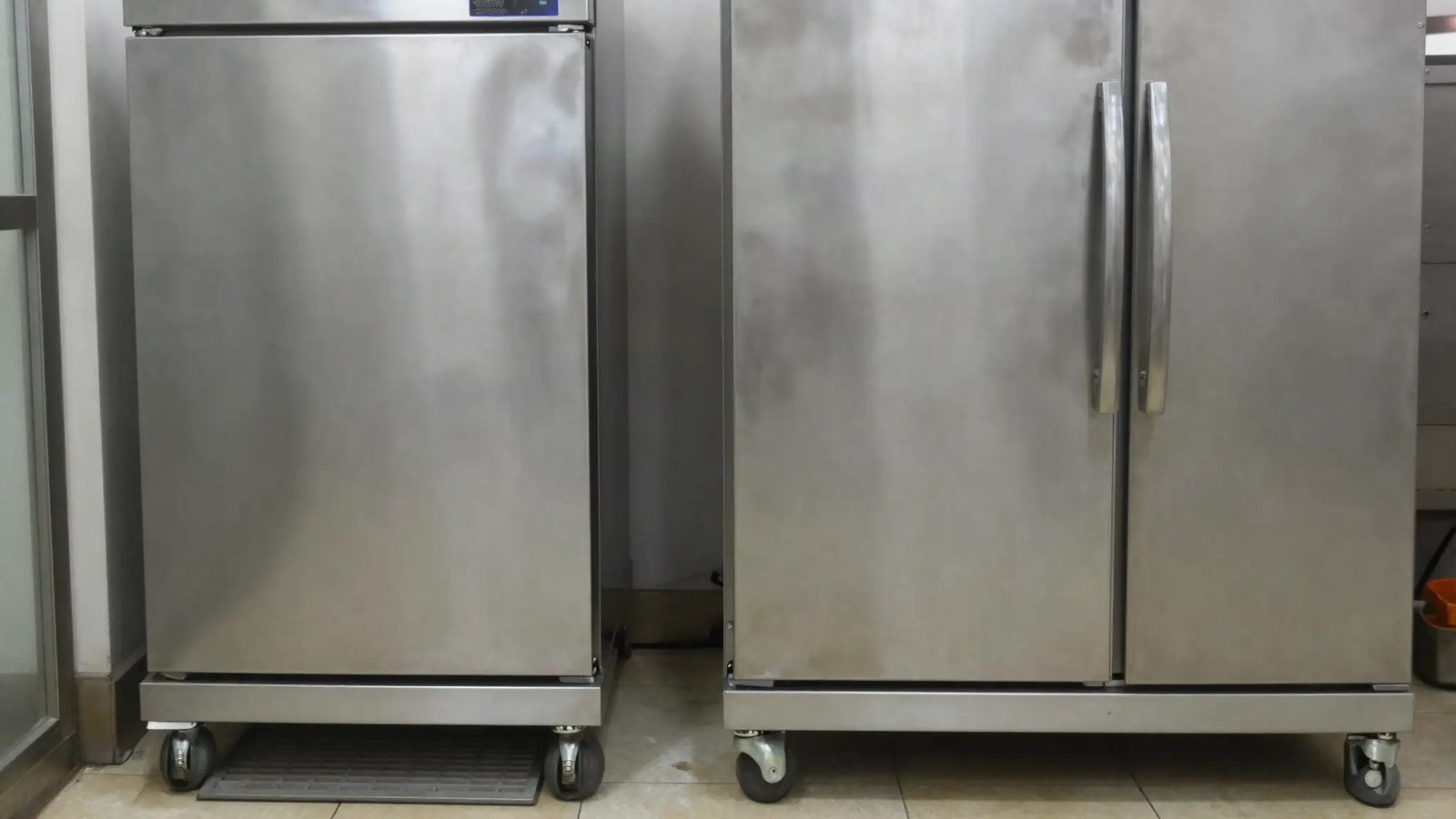
Every piece of commercial refrigeration in a kitchen runs the same 4 part cycle, and the two things that change between them are where the condenser sits and how the unit sheds ice. Food has to hold at 41F or below under the FDA Food Code, which is the number every setpoint in the building works back from.
The short version
A mid-sized restaurant runs 6 to 8 separate pieces of refrigeration. A walk-in cooler, a walk-in freezer, two or three reach-ins, a prep table, an undercounter unit under the saute station, an ice machine, and in a bar a bottle cooler nobody mentions until it fails.
They look like 8 different problems. They are one cycle in 8 cabinets, and almost every service call lands on the same short list of causes.
Two questions tell a dispatcher most of what the call will be before anyone is on site. Where is the condenser, and how does the ice come off the evaporator.
Everything else is the detail of the box it was built into.
What is the refrigeration cycle actually doing?
It is moving heat out of a box, not making cold inside one. That distinction explains why a unit in a hot corridor fails in July and works in October with nothing repaired.
Four components do the work, and each one fails in a way the kitchen describes differently.
| Component | What it does | What the kitchen reports when it is the problem |
|---|---|---|
| Compressor | Raises the pressure of the refrigerant vapor and moves it around the circuit | "It runs all the time and never gets cold", or a unit that trips a breaker |
| Condenser | Rejects the heat to the air, where the refrigerant turns back to liquid | "It only struggles in the afternoon", or a box that holds overnight and drifts by 2pm |
| Metering device | Drops the pressure and controls how much refrigerant reaches the evaporator | "Some days it freezes the lettuce, some days it is warm" |
| Evaporator | Absorbs heat from the box, where the refrigerant boils back to vapor | "The coil is a block of ice", or water on the floor |
A technician reads the state of that cycle with two numbers taken at the equipment, superheat and subcooling, and those two numbers separate a charge problem from an airflow problem before anything is opened up. Superheat and subcooling is its own subject and worth reading on its own.
Where does the condenser sit, and why does it decide the service call?
The location of the condenser is the single biggest difference between two units that hold the same temperature. It sets who is responsible for the heat, how long the repair takes, and whether one failure takes out one cabinet or the whole kitchen.
| Arrangement | Where the condenser is | Typical in a kitchen | What it means for service |
|---|---|---|---|
| Self-contained | In or on the cabinet itself | Reach-ins, prep tables, undercounter units, bottle coolers | One failure, one cabinet. The condenser breathes kitchen air, so it loads with grease and dust fast |
| Remote condensing | On the roof or an exterior pad, piped to the box | Walk-in coolers and freezers | Quieter and cooler in the kitchen, and the diagnosis now involves a roof, a ladder and line sets |
| Parallel rack | Several compressors in a compressor room feeding many circuits | Supermarkets, large institutional kitchens, some hotels | One rack problem reaches many cases at once, and the work needs a technician who reads the controller |
This is why "the walk-in is down" and "the prep table is down" are different calls with different parts, different travel and different downtime for the customer, even though both boxes failed to hold 41F.
It also decides what a technician must carry. A self-contained unit is often a fan motor, a relay or a cleaning. A remote system is gauges, a recovery setup and the line set.
How does the ice come off the evaporator?
Every evaporator running below freezing collects frost, and how the unit removes it is the second question that shapes the service call. Three methods cover nearly everything in a kitchen.
- Off-cycle or air defrost: the compressor stops and box air above freezing melts the frost. Used in coolers, which is why a cooler evaporator ices up when the unit never gets an off cycle
- Electric defrost: heaters in the coil melt the frost on a timed or demand schedule. Standard in freezers, and a failed heater or a failed termination sensor shows up as a solid block of ice
- Hot gas defrost: hot discharge gas is routed through the evaporator to melt the frost from inside the coil. Common on larger systems and racks, and faster, with valves that can stick
Most "the box is warm and the unit is running" calls are a defrost fault or an airflow fault rather than a refrigerant fault. Frost insulates the coil, air stops moving across it, and the box drifts while the compressor runs continuously because the thermostat never gets satisfied.
Two things worth checking before gauges go on: the drain line and the door. A blocked or unheated drain refreezes the meltwater and builds ice under the coil. A door that no longer seals feeds humid kitchen air to a coil that was never sized for it.
What temperature should each piece hold?
The food number comes from the FDA Food Code, which puts cold holding of time and temperature control for safety food at 41F or below. Every setpoint in the kitchen is chosen to stay under that during a lunch rush with the door opening constantly.
Which is why a cooler setpoint sits below the holding number rather than at it, a freezer runs at or below 0F for product quality as well as safety, and the number on the dial is not the number an inspector measures.
Three distinctions that cause arguments with customers:
- Air temperature is not product temperature. The thermometer reads the air near it. A health inspector probes the food, and a pan on top of a full prep table can be warmer than the box average
- Average is not maximum. A box that cycles between 36F and 44F averages fine and fails an inspection at the wrong moment
- Recovery matters more than setpoint. How fast the box comes back after 20 minutes of loading is the real measure of whether the equipment still fits the kitchen
A service company that records the temperature it measured at each visit, on the equipment rather than in a note, can show a customer a drift over 6 months instead of arguing about one reading.
Which piece fails first, and what does it look like?
Failure is not evenly distributed. The equipment that sits in the hottest, dirtiest, most frequently opened part of the kitchen fails most, and that is rarely the walk-in.
| Equipment | Why it fails | First thing to look at |
|---|---|---|
| Prep table | Hot line above it, condenser breathing grease, lid open through service | Condenser coil, gasket, pan loading |
| Undercounter unit | No clearance, mopped against, highest ambient in the building | Clearance and airflow, then the fan motor |
| Reach-in | Door cycles hundreds of times a shift | Gasket, hinge, door closer, then defrost |
| Walk-in cooler | Door propped during deliveries, drain blocked, coil iced | Door and drain before anything electrical |
| Walk-in freezer | Defrost termination, heaters, infiltration through a failed door seal | Defrost cycle and its termination, then the heaters |
| Ice machine | Water chemistry rather than refrigeration | Filter age, scale on the sensor, condenser |
| Bar and bottle coolers | Sealed in a cabinet with no ventilation, often behind a kick plate | Air path in and out of the cabinet |
Ice equipment is the one piece on that list where the refrigeration side is usually healthy and the water is the fault, which is why ice machines get their own diagnostic path.
What does the kitchen do that shortens equipment life?
Most premature failure in a commercial kitchen is environmental rather than mechanical, and all of it is avoidable by the operator rather than the technician.
- Storage stacked against a condenser intake, which is the most common one and the cheapest to fix
- Hot product loaded straight into a cooler, which runs the unit at full tilt for an hour and ices the coil
- Doors propped during a delivery, so a cooler spends 20 minutes pulling in humid air
- Hose-down cleaning near a self-contained condensing section, where water and grease make a paste on the coil
- Grease-laden air from an under-performing hood, which coats every coil in the room
- A unit that was specified for a different kitchen, usually after a menu change doubled the covers
Naming those at the visit is worth more to the customer than the repair, and it is the difference between a vendor and a service partner. A planned visit that clears coils and checks doors prevents the emergency call that follows a holiday weekend, which is the argument behind a structured maintenance agreement.
What is changing in the equipment being installed now?
New refrigeration is arriving with different refrigerants, and the change reaches the service company before it reaches the kitchen. Many new units use A2L refrigerants, which are mildly flammable, and the second edition of UL 60335-2-89, approved in 2021, is the standard that raised the permitted charge sizes for them in commercial refrigeration.
What that means in practice, for a company that services equipment rather than designs it:
- Charge limits are calculated from the specific refrigerant, because the lower flammability limit differs between A2L blends
- New equipment ships with leak detection, isolation valves and control logic built around the refrigerant, so a sensor fault is now a no-cool call
- Recovery equipment, gauges and leak detection on the van have to be rated for the refrigerant in the unit
- CO2 systems are appearing in larger kitchens and supermarkets, and they run at pressures that need their own training
The handling and record keeping side of this sits in the federal rules, and those changed in 2026 for smaller equipment. EPA 608 and refrigerant handling covers which certification each technician needs and what has to be on file.
Roopairs runs a product tour where you can see equipment records per asset, service history and maintenance schedules held on the equipment itself.
What the service company should hold on each piece of equipment
The reason this matters commercially is that every useful question about refrigeration is a question about one unit over time, not about a customer.
- Model and serial, which decide the parts and the procedure
- Refrigerant type and full charge, because every leak threshold is a percentage of the charge
- Arrangement: self-contained, remote or on a rack, and where the condenser physically is
- Defrost type and the setting it was last left at
- Temperature measured at each visit, with the ambient on the day
- Repairs with the parts fitted, so the third fan motor in a year is visible as a pattern
Six facts per unit. A company that holds them can tell a customer which box to replace and which to keep, and that conversation is the one that gets a capital budget approved.
What service companies in the trade say
“Loving the software so far. Running a commercial refrigeration company with a small residential hvac client base.” — Aaron Anderson
Also worth reading
- Superheat and Subcooling: Reading What the System Tells You
- EPA 608 and Refrigerant Handling
- Refrigeration Service Management Software
Frequently asked questions
What are the main types of commercial refrigeration in a restaurant?
Walk-in coolers and freezers, reach-ins, prep tables, undercounter units, ice equipment and bar coolers. They divide into self-contained units with the condenser on the cabinet, remote systems with the condenser outside, and parallel racks feeding many circuits from a compressor room.
What temperature should a walk-in cooler hold?
Cold enough that food stays at 41F or below, which is the FDA Food Code limit for cold holding of time and temperature control for safety food. In practice the box is set below that number so it stays under the limit through a service rush with the door opening repeatedly.
Why is the box warm when the unit is running constantly?
Usually a defrost or airflow fault rather than a refrigerant fault. Frost on the evaporator insulates the coil, so the box never reaches setpoint and the compressor never stops. Check the defrost cycle, the drain line, the fans and the door seal before putting gauges on.
What is the difference between a self-contained and a remote condensing unit?
Where the heat is rejected. A self-contained unit carries its condenser on the cabinet and dumps the heat into the kitchen, so one failure affects one cabinet. A remote system has the condenser outside, which keeps the kitchen cooler and makes every diagnosis a two location job.
Why does a prep table fail more often than a walk-in?
Because of where it stands. A prep table sits under the hot line, breathes grease-laden air through a condenser at knee height, and has its lid open through every service period. The walk-in has a bigger system in a cooler place and is opened less often.
What is hot gas defrost?
A defrost method that routes hot discharge gas from the compressor through the evaporator to melt frost from inside the coil. It is faster than electric defrost and common on larger systems and racks. The valves that redirect the gas are a known failure point.
What do A2L refrigerants change for a service company?
They are mildly flammable, so permitted charge sizes are calculated per refrigerant and new equipment ships with leak detection, isolation valves and matching control logic. Recovery equipment, gauges and leak detection have to be rated for the refrigerant, and a failed sensor now presents as a no-cool call.
See how Roopairs can help your service business scale
The all-in-one platform built for commercial kitchen service companies. Dispatch, invoicing, parts ordering — all in one place.
Book a product tour →