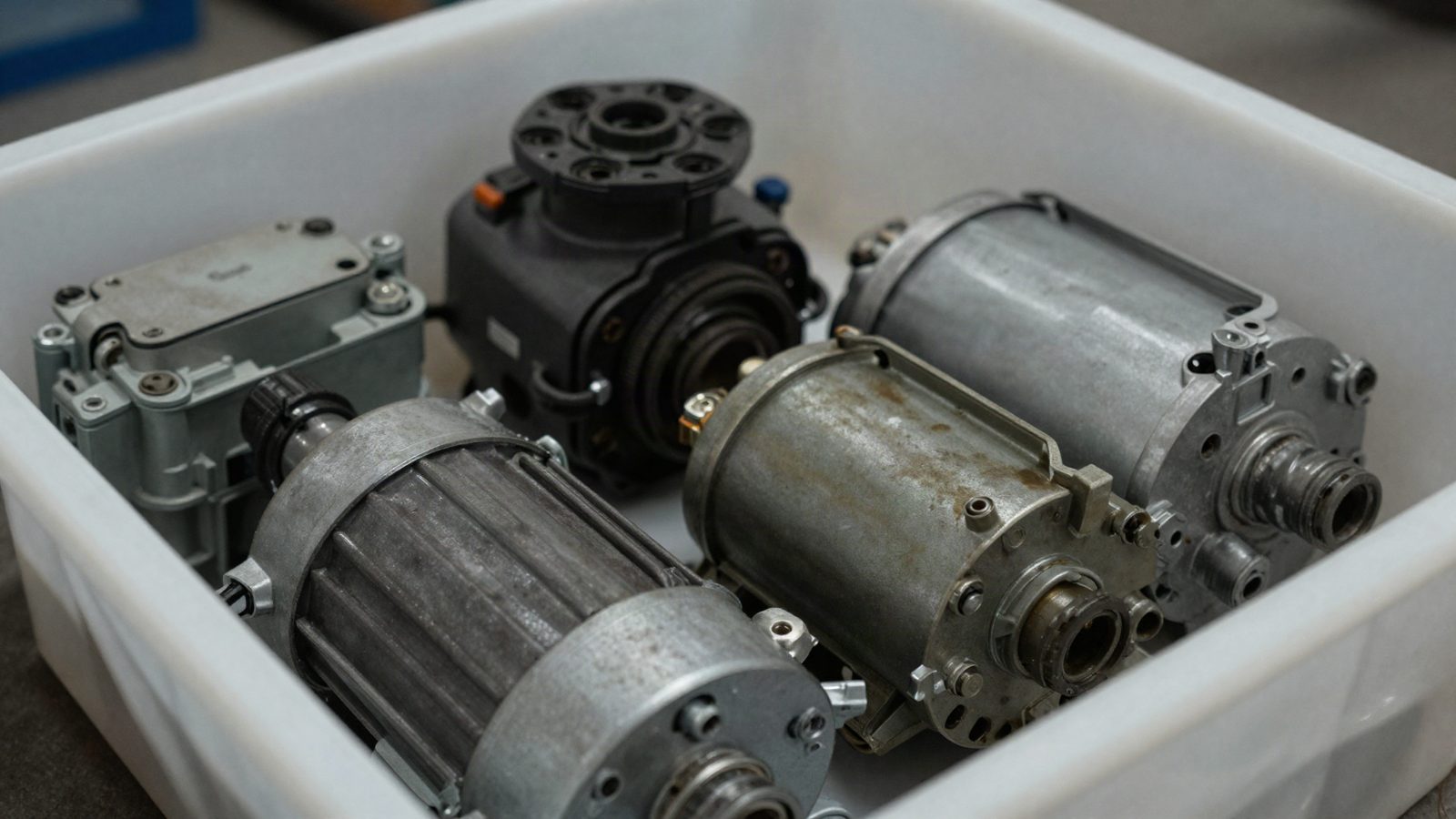
Cycle counting checks a small slice of inventory on a rolling schedule instead of counting everything once a year. For a service company that means roughly 32 line counts a week rather than 400 in one weekend. The hard part is not the counting. Your inventory sits across the warehouse and every van, and it moves while you count.
The short version
- An annual count means shutting down for a weekend, and the numbers are wrong again by Wednesday.
- Cycle counting spreads the same work across the year in slices small enough to do on a normal Tuesday.
- In a service business the complication is location. A compressor is either in the warehouse, on a van, or already installed, and only one of those is countable.
- Start with the parts that move: the 20 percent of your SKUs that account for most of your consumption.
- Count the vans on a different cycle from the warehouse, because they are wrong in a different way.
- The count is only worth doing if what you find changes the system of record. Otherwise it is exercise.
Why the annual count stops working around your third or fourth technician
A one-technician service company knows its inventory. The parts are in the van, the technician put them there, and if a relay is missing they know why.
Add technicians and that knowledge stops being in anyone's head. The pain starts around your third or fourth technician, and it is cheaper to move before it does, and inventory is one of the first places it shows. Six vans is six moving warehouses, each stocked slightly differently, each drawn down at a different rate, and none of them visible from the office.
The annual count is the traditional answer. Close on a Saturday, count everything, reconcile, reopen. It has two problems: it costs a weekend of labor, and the accuracy it buys decays immediately.
By the following Friday twenty jobs have consumed parts, three vans have been restocked from the warehouse, and two orders have arrived. The number you fought for on Saturday is already historical.
What is cycle counting, and how is it different?
Cycle counting audits a subset of inventory on a repeating schedule, so that over a period, usually a quarter or a year, everything gets counted, but nothing gets counted all at once.
The mechanical difference is that a cycle count does not require the business to stop. The practical difference is more important: because you count the fast-moving parts more often, you find errors while they are still small, and you find the cause while someone still remembers it.
A discrepancy found in an annual count is a mystery. A discrepancy found nine days after it happened usually has an obvious explanation: a part went on a job and never made it onto the work order.
Is cycle counting the same as taking inventory?
Both are physical counts. The difference is scope and frequency. Taking inventory usually means counting everything, once. Cycle counting means counting a slice, repeatedly, forever.
Cycle counting can replace the annual count entirely, and in most service companies that is the point of doing it.
The 80/20 split, applied to a parts room
The common name for this is ABC analysis, and the underlying observation is that a small share of your part numbers accounts for most of your activity.
In a commercial kitchen service company that shape is usually pronounced. Contactors, capacitors, gaskets, thermostats, igniters and common refrigeration valves turn over constantly. A control board for one manufacturer's combi oven might sit on the shelf for eight months and then leave in a hurry.
| Class | What it usually is | Count how often |
|---|---|---|
| A | The fast movers. Small in number, most of your consumption, and what a stockout actually costs you. | Monthly |
| B | Steady but slower. Model-specific parts for equipment you see regularly. | Quarterly |
| C | Slow and often expensive. Boards, compressors, one-off assemblies. | Twice a year, and reconcile by value rather than by count |
The classification is not permanent. A part becomes an A part when you win an account with forty of that model, and nobody updates the classification because nobody owns it. Review it when the customer mix changes, not on a calendar.
How is a cycle count calculated?
Two numbers matter. The first is how many counts you need per period, which is the number of parts in each class multiplied by that class's frequency. The second is accuracy, which is the count of items where the physical quantity matched the recorded quantity, divided by the number of items counted.
A worked example. A service company carries 400 part numbers: 60 A parts counted monthly, 140 B parts counted quarterly, 200 C parts counted twice a year. That is 720 plus 560 plus 400, so 1,680 line counts a year, or roughly 32 a week. Thirty-two counts is under an hour for one person who is not also answering the phone.
Compare that with a single annual count of 400 line items done by three people over a Saturday, and the arithmetic favors the cycle count before you account for the accuracy difference.
The part that generic guides get wrong: your inventory is on the road
Almost everything written about cycle counting assumes a warehouse. Fixed shelves, a fixed door, and stock that only moves when somebody moves it deliberately.
A service company is not that. At any moment a given part is in one of four states, and only two of them are countable.
| Where the part is | Countable? | What goes wrong |
|---|---|---|
| Warehouse shelf | Yes | Straightforward, and the smallest source of error |
| Van stock | Yes, if the van is there | The van is on a job. Counting it means catching it, which is a scheduling problem, not an inventory one |
| Consumed on a job, not yet on the work order | No | The single largest cause of discrepancy in a service business |
| On order, or in transit from a supplier | No | Counted as missing when it is simply not here yet |
That third row is where most of the error comes from, and it is not really an inventory problem. It is a documentation problem that shows up as an inventory problem.
A technician pulls a capacitor off the van at 4pm, fits it, and closes the job from the parking lot. If the part never reaches that work order, three things are wrong at once: the van count, the customer's invoice, and the job's margin.
This is why counting more often helps beyond the count itself. A monthly count on A parts surfaces that pattern within weeks, and it is usually one or two people who need a different habit rather than a systemic failure.
A four-week cycle that fits a real week
The schedule below assumes one person doing the counting, roughly an hour a week, and no shutdown.
| Week | What gets counted | Why then |
|---|---|---|
| 1 | All A parts on the warehouse shelf | Start where the value and the movement are. Tuesday or Wednesday morning, before the parts orders land. |
| 2 | Half the vans, full count | Catch them at the warehouse at the start of the day. Pair it with whatever maintenance or restock is already happening. |
| 3 | The other half of the vans, plus one B class group | Splitting the fleet keeps any single week under an hour. |
| 4 | One C class group, by value | Slow movers need verification more than they need frequency. Reconcile cost, not just quantity. |
Two rules make this survive contact with a busy month. Count at the same point in the week every time, because a count taken on a Friday afternoon and compared against one taken on a Monday morning is not comparing like with like. And never count a van the same week it was restocked, or you are auditing the restock rather than the consumption.
What to do with a discrepancy
A count that ends with an adjusted number and nothing else has solved the symptom. The value is in the second question.
- Adjust the record. The physical count is the truth. Fix the system to match it, and date the adjustment.
- Find the job. Look at the work orders that touched that part number since the last count. Most shortfalls resolve to a specific job where the part was fitted and never recorded.
- Fix the invoice if it is still open. A part fitted and not billed is margin that left the building. If the invoice has gone out, decide deliberately whether to raise it, and note what it cost.
- Look for the pattern before the person. If the same part number goes missing every month, it is often a part that is fitted in pairs and ordered singly, or one where two suppliers use different part numbers for the same thing.
- Write down what you found. One line per adjustment. Six months of those lines is the most useful inventory document a service company will ever have.
Why this is harder in software built for residential work
Purchase orders, parts inventory management and equipment asset tracking are among the biggest components of a field service platform that are missing from products built for residential trades. A homeowner job does not carry a parts chain. Once commercial equipment is involved you inherit thousands of part numbers, the inventory that holds them, and the purchase orders and bills that track them in and out.
The practical consequence for cycle counting is specific. If the software has no concept of stock held against a van, counting van stock means a spreadsheet next to the software, and reconciling the two is a second job. If parts consumed on a job do not attach to the work order automatically, the largest source of discrepancy has no audit trail at all, and every count ends with a mystery instead of a job number.
Roopairs holds parts inventory and purchase orders in the same place as the work order and the equipment record, which is what makes step two of the discrepancy process possible: from a short count to the specific job in one move rather than a search through paperwork.
Getting started this month
Do not classify 400 parts before your first count. Take the twenty part numbers you order most often, count them on Wednesday morning, and write down what you find. That is a useful hour, and it will tell you more about where your parts go than a plan will.
Add the vans in week two. Add the classification once you have three or four counts behind you and can see which parts actually move, rather than which ones you believe move.
See how Roopairs handles parts, purchase orders and work orders in one place, or start with an overview of what it does.
What service companies in the trade say
“Roopairs makes it easy for myself and my employees to keep records of each customer, every part number, cost, equipment details, names, order requests, estimates, you name it- all kept on file in one place. This app saves my company and me tons of time.” — A&E Refrigeration
Also worth reading
- Food Inventory or Parts Inventory? Two Products, One Search Term
- Parts Inventory Management for Equipment Service
- Service software built to manage purchase orders and inventory
Frequently asked questions
What is the 80/20 rule for cycle counting?
It is the observation that roughly 20 percent of your part numbers account for roughly 80 percent of your activity. In practice it means counting that small group often, monthly for most service companies, and counting the slow movers a few times a year. The exact ratio in your service company will not be 80/20, and it does not need to be. The point is that frequency should follow movement.
How often should you cycle count inventory?
Fast-moving parts monthly, mid-range quarterly, slow and expensive parts twice a year. Van stock deserves its own rhythm, usually every four to six weeks, because it is wrong in a different way from shelf stock and for different reasons.
Can cycle counting replace an annual physical inventory?
In most service companies, yes, provided the cycle covers everything within the year and the adjustments are recorded as you go. Check with your accountant before dropping the annual count, because the answer can depend on how your books are prepared and what your lender or insurer expects to see.
Who should do the counting?
Not the person who ordered the part and not the person who fitted it, where you can manage that. A second pair of eyes is the whole control. In a small service company that often means the office manager counts what the technicians consume, which works fine and has the side benefit of putting the person who bills the parts in front of the parts.
How do you count stock that is on a van out on a job?
You do not. You schedule around it. Count vans at the start of the day before they leave, or count them on the day they come in for service. Trying to count a van remotely produces a number nobody trusts, and a number nobody trusts is worse than no number.
What accuracy should we be aiming for?
Measure it before you set a target. Count your top twenty parts, record how many matched, and that is your starting point. Most service companies that have never counted systematically find their first number uncomfortable. The useful goal for the first quarter is that the number improves, not that it hits a benchmark from a warehousing article.
See how Roopairs can help your service business scale
The all-in-one platform built for commercial kitchen service companies. Dispatch, invoicing, parts ordering — all in one place.
Book a product tour →