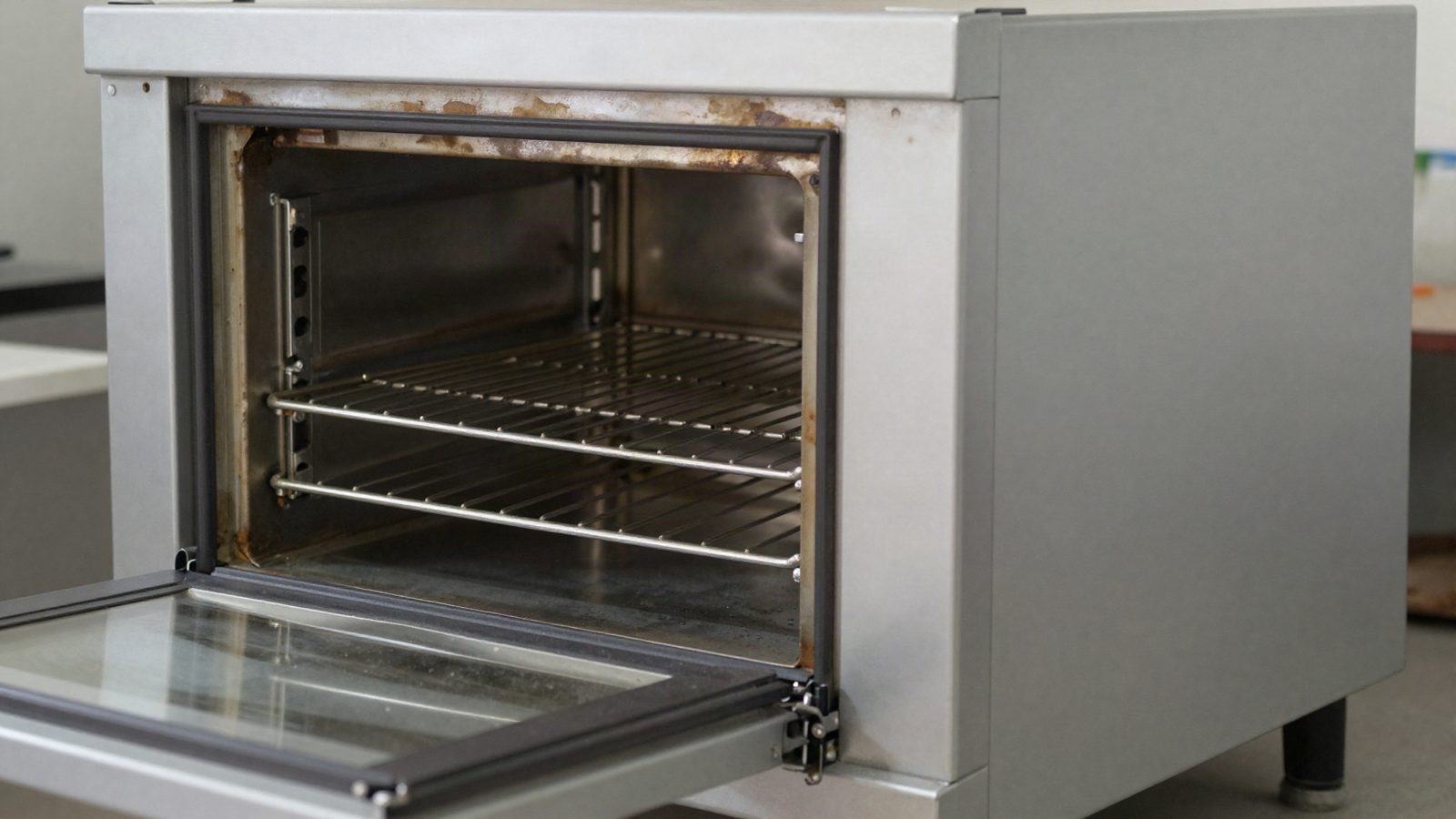
A fryer out of service costs a restaurant 4 things and your invoice is the smallest of them. The argument works when it is built from their numbers, and it stops working the moment you estimate any of the 4 on their behalf.
The short version
Every conversation about maintenance, response commitments and replacement runs into the same wall: the operator is comparing a known cost against an unknown risk.
The repair bill is concrete. The cost of the equipment being down is vague, and vague loses to concrete every time.
Making it concrete is the whole job, and it has to be done with the operator rather than at them. A number you calculated on their behalf is a sales argument, and the same number they worked out is a decision.
The 4 costs of a piece of equipment out of service
| Cost | How the operator sees it |
|---|---|
| Lost sales | Items removed from the menu during service |
| Wasted labor | Staff rostered for a kitchen that cannot produce |
| Wasted stock | Prepared food, or product in a failed refrigerated unit |
| The repair itself | Your invoice, usually the smallest of the four |
The first is the one operators can calculate instantly and rarely have. They know what a fryer-dependent section sells on a Friday, and nobody has ever asked them to write it down.
Ask, do not estimate
The single rule that makes this credible.
Four questions, asked once, and the operator answers all of them from their own knowledge in about two minutes.
What does the section that depends on this equipment take on a busy service. How many staff are on during that period. What happens to prepared stock if it is not used. And how long could you run without it before you would have to close a section.
Those four produce a number that belongs to them. You are not persuading anybody, you are asking them to look at their own arithmetic, which is a considerably stronger position.
What you contribute is the other half: how long the repair actually takes, how often this equipment has failed, and what the part lead time looks like.
Your half of the number comes from the equipment's history
And it is what separates this from a generic argument.
How many times this specific unit has been attended, what for, what was recommended and declined, and how long each failure took to resolve including waiting for parts.
Roopairs holds equipment asset records with manufacturer, model and serial per site and job history attached to the equipment, which is what makes that half of the conversation specific rather than categorical.
A statement like "this fryer has been down four times in two years, the last one for three days waiting for a part" is a fact about their kitchen. "Equipment failures are costly" is an advertisement.
Where the history does not exist, the honest version is to say so and start recording, and to have this conversation properly in a year.
Downtime is not the same across the week
Which is where most versions of this argument overreach.
A fryer failing on a Tuesday morning is an inconvenience. The same fryer failing at seven on a Friday is a different event entirely, and multiplying an average by a number of hours produces a figure the operator will not recognize.
So the useful framing is the bad case rather than the average: what a failure costs when it happens at the worst time, and how often that risk is live.
That is also the honest framing, because the argument for maintenance and response commitments is about the shape of the distribution rather than about the mean.
Where this argument stops being honest
Two places, and both damage the relationship when crossed.
Attaching a large annual figure to a single equipment by extrapolating one bad night across a year. Operators can do arithmetic and they will check it.
And using the number to argue that maintenance prevents everything. It prevents the gradual failures and it does not prevent a control board dying without warning, and claiming otherwise loses the argument the first time that happens.
The credible version is narrower and it survives contact with reality: this is what a bad failure costs you, this is how often we see these on equipment of this age, and this is what can and cannot be prevented.
3 conversations this number changes
- Repair against replacement. A unit costing several bad days a year is a capital decision, not a repair decision
- Response commitments. Four hours against next day has a value they can now calculate
- Declined recommendations. A component quoted and refused has a cost attached to refusing it
The first is where it matters most. Operators replace equipment when it dies, and a replacement planned in a quiet month costs a fraction of one forced during service.
Write it down and give it to them
Because the conversation fades and the document does not.
A short note per piece of equipment: the age, the failure history, what a bad failure would cost by their own numbers, and what the options are.
That document goes into a budget conversation you are not present for, which is where equipment decisions are actually made.
And it is the thing a competitor quoting on price cannot match, because they do not hold the history that makes it specific.
Send it to the person who decides rather than to the kitchen. Equipment budgets are set above site level in any group, and a document that stops at the manager who agreed with you has not reached the conversation it was written for.
The pain starts around your third or fourth technician, which is where nobody remembers which equipment have failed how often, and this conversation becomes impossible without records.
Roopairs runs a product tour where you can see per-equipment records and the failure history behind them.
What service companies in the trade say
“Everything about the product is cutting edge and specifically tailored to the food service equipment repair industry.” — Jeff Victory
Also worth reading
- Special-Order Parts: Managing the Customer
- What Preventive Maintenance Actually Prevents
- Why 2026 tariffs are making commercial kitchen equipment repair more critical
Frequently asked questions
What does a down fryer actually cost a restaurant?
Four things: lost sales from items off the menu, labor rostered for a kitchen that cannot produce, wasted stock, and the repair itself, which is usually the smallest of the four.
Should you calculate the number for them?
No. Ask four questions and let them answer from their own knowledge. A number you produced is a sales argument, and the same number they worked out is a decision.
What is your half of the conversation?
The equipment's history: how often this unit has failed, what for, what was recommended and declined, and how long each failure took including waiting for parts.
Why not use an average hourly cost?
Because a Tuesday morning failure and a Friday evening failure are different events. Multiplying an average across hours produces a figure the operator will not recognize, and the bad case is both more useful and more honest.
Where does this argument overreach?
Extrapolating one bad night across a year, and claiming maintenance prevents everything. It prevents gradual failures and not a control board dying without warning.
Which conversations does the number change?
Repair against replacement, the value of a response commitment, and the cost of declining a recommendation. The first matters most, since a planned replacement costs a fraction of one forced during service.
See how Roopairs can help your service business scale
The all-in-one platform built for commercial kitchen service companies. Dispatch, invoicing, parts ordering — all in one place.
Book a product tour →