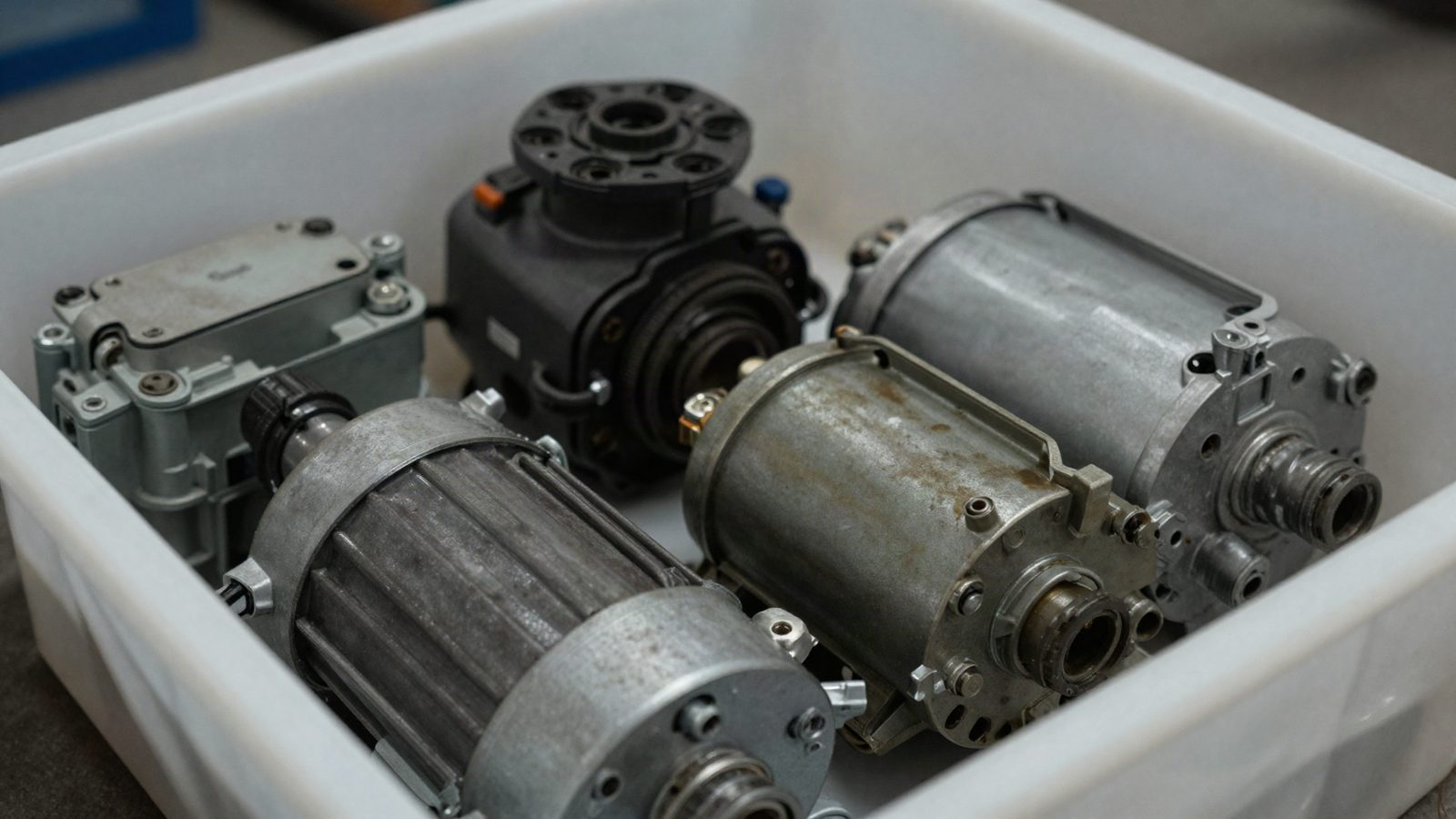
A parts room for a small service company has 4 areas rather than shelves: stock that loads vans, parts committed to a named job, cores and returns going back, and receiving. Mixing the first two is the mistake that costs the most, because a committed part picked for another job creates two problems at once.
The short version
General advice on organizing a store room assumes the parts stay there. In a service company they do not. The room exists to load six vans on a Monday morning and to hold the parts that belong to specific jobs already diagnosed.
That changes the layout. Fast movers go where a technician can reach them without walking, because they get picked every day by people already late. Slow movers can go up high. And the parts that belong to a named job need to be physically separated from stock, or they will be fitted at the wrong address.
What good looks like:
- Four areas, physically distinct, not four labels on one rack
- Fast movers at waist height near the door
- Committed parts in a bay per job, with the work order number visible
- A cores and returns shelf with a deadline written on it
- One person responsible, named, not the whole team
The room's job is to load vans, not to store parts
Every layout decision follows from this and most parts rooms are laid out as if it were not true. Storage layout optimizes for density. Loading layout optimizes for how fast six people can get out of the building.
Watch what actually happens at 7am. A technician arrives, checks the board, sees a compressor job at a site forty minutes away, and needs three things: the part for that job, the consumables to get through the day, and something to write on. If any of those means walking to the far corner of the room, it comes out of billable time every single morning.
So the geography is:
- Nearest the door, waist height: consumables and the fastest movers. Gaskets, fasteners, common contactors, capacitors, thermostats, whatever your own history says you fit weekly.
- Middle of the room: the rest of the stocked catalog, sorted so a technician can find something they have not picked before.
- High shelves and back wall: slow movers, bulky items, and anything you hold because lead times are long rather than because it moves.
- Separate bay, clearly not stock: parts committed to jobs.
Which parts belong in the first group comes out of your own service history rather than a supplier catalog, and working that out is a separate exercise from arranging the room.
4 areas, and 2 of them are usually missing
Most service companies have stock and receiving. The two that get skipped are committed parts and returns, and those two are where the money leaks.
| Area | What lives there | What happens without it |
|---|---|---|
| Stock | Parts you hold because they get used, service company copy and van restock | Nothing. Every service company has this one |
| Committed | Parts ordered for a named job, waiting for the visit | The part is picked for a different job. Two customers wait and one purchase order is now wrong |
| Cores and returns | Cores owed back, warranty parts to return, wrong parts to send back | Cores are never claimed, credits never arrive, and a corner of the service company fills up with things nobody will throw away |
| Receiving | Everything that arrived today, until it is booked in | Parts go straight to a shelf unrecorded, and the count is wrong from the moment the delivery arrives |
The receiving area matters more than it looks. A part that reaches a shelf without being booked in is invisible to everyone not standing in front of it, and it is the most common single cause of ordering something you already own.
A committed-parts bay is what stops the Friday afternoon problem
This is the highest-value change in the room and it costs a rack and some masking tape.
The failure runs like this. A compressor is ordered on Tuesday for a walk-in at store 212. It arrives Thursday and goes on the shelf next to the other compressors. Friday afternoon a different technician needs a compressor for an urgent call, takes that one because it is there, and fits it at a different customer.
Now there are three problems. Store 212 waits another week. The purchase order created for that job paid for a part fitted somewhere else, so both jobs have the wrong cost. And nobody notices until the supplier bill arrives and no longer matches anything.
The physical fix is a bay per open job with the work order number written where a technician sees it before reaching. A shelf of plastic tubs works. What makes it hold is one rule: nothing leaves the committed bay without checking the work order number, and if a part genuinely has to be reassigned, the paperwork moves with it.
The systems side of this is the purchase order sitting against the job rather than against the month, which is what makes the reassignment traceable at all. Roopairs has written about keeping purchase orders and inventory in the same place as the work order, and the bay is the physical half of that idea.
Bin size follows how the part is picked
Bin sizing is where small-parts organization succeeds or turns into a drawer of mixed fasteners within a month.
Three rules that hold up in a service company:
- One part number per bin, always. The moment two similar parts share a bin, the count is gone and so is the confidence. Two bins next to each other beats one bin with a divider.
- Bin size matches a month of use, not a year. An oversized bin hides how much is left. Small bins that look empty are a feature, because empty is a signal.
- Pick location, not part family. Grouping by manufacturer looks tidy and means a technician walks the room. Grouping by how often something is picked looks messy and gets vans out faster.
For anything with a core charge or a serial number, use a bin big enough to hold the paperwork with the part. Separating a part from its documentation is the same failure as separating it from its job.
Disassembled parts need a job number, not a shelf
A unit taken apart mid-repair is not inventory and it should never touch a stock shelf. The parts belong to one job and they are meaningless without knowing which.
What works is a tray or tub per job in progress, labeled with the work order number and the date, kept in the committed area rather than in stock. If a job in progress sits for more than a week, that is a signal in itself and worth a look on the board rather than in the room.
Photograph the assembly before it comes apart. That habit costs thirty seconds and saves a phone call to the manufacturer on a Thursday afternoon.
Cores and warranty returns need a shelf with a deadline
Cores and warranty returns are money sitting in a corner, and they expire. A core owed back to a supplier is a credit you have already paid for. A warranty part not returned within the manufacturer's window becomes a part you bought.
The practice is simple and it needs the deadline written down:
- One shelf, visible, near the door. Not the back of the room, because out of sight is the whole problem.
- Every item labeled with the job number and the date it landed there.
- A weekly ten minutes to clear it. Same slot every week, one person.
- A wrong-part sub-shelf, because parts ordered in error have a shorter return window than cores and get forgotten first.
The OEM and non-OEM decision affects this too, since return terms and core arrangements differ between an original part and an equivalent. Roopairs covers where OEM and non-OEM parts each make sense in this industry in more detail.
Who owns the room at three or four technicians
Below about three or four technicians the room has an owner whether or not anyone said so, and it is usually the person who started the company. They stocked it, so they know it.
Above that the knowledge stops fitting in one head, and a room owned by everyone is owned by nobody. What works at this size is one named person, usually the office or a lead technician, with three specific responsibilities: booking in what arrives, clearing the returns shelf weekly, and deciding when a stocking level changes.
That is not a full-time job. It is roughly an hour a day and it is the difference between a room that degrades and one that holds. Where it goes wrong is leaving it as an implied duty on top of dispatch, because dispatch always wins on a bad Tuesday.
Setting this up over 3 Saturdays
You do not need to close for a week or empty the room.
Saturday one: separate the four areas. Physical separation first, before any sorting. A rack for committed parts, a shelf for cores and returns, a table for receiving. Tape and a marker are enough for the labels at this stage.
Saturday two: move the fast movers forward. Pick the twenty or thirty part numbers your technicians reach for weekly and put them at waist height near the door. Leave everything else where it is.
Saturday three: one part number per bin for the fast movers only. The rest can wait until it annoys someone.
Then run the two habits: nothing leaves the committed bay without checking the job number, and the returns shelf gets cleared every week. Those two carry more of the result than the tidying does.
If you want to see the systems half of this, with purchase orders created inside a job and parts tracked across the service company and the vans, Roopairs runs a product tour where you can walk one of your own parts jobs through it.
What service companies in the trade say
“The software allows me to input jobs, keep track of parts, and easily bill customers, helping me streamline my workflow and save time.” — Daniel Argueta
Also worth reading
- Warranty Parts vs Your Stock: Keeping Them Apart
- Cycle Counting Inventory for Service Companies
- Why field service technician productivity starts on the job site
Frequently asked questions
What is the best way to organize a parts room?
By how often a part is picked rather than by manufacturer or part family. Fast movers at waist height near the door, slow movers high and at the back, and parts committed to specific jobs physically separated from stock. Organizing by family looks tidier and makes technicians walk further every morning.
What is the best way to organize small parts?
One part number per bin with no exceptions, and bins sized for about a month of use rather than a year. Shared bins destroy the count within weeks, and oversized bins hide how much is left. A bin that looks empty is doing its job.
How do you organize a supply room in a service business?
Start with four physically separate areas: stock, parts committed to named jobs, cores and returns, and receiving. Most service companies have the first and the last. The two in the middle are where parts get fitted at the wrong address and where credits quietly expire.
How should disassembled parts be organized?
In a labeled tray or tub per job, kept with committed parts rather than on a stock shelf, marked with the work order number and the date. Photograph the assembly before it comes apart. Disassembled parts are not inventory and treating them as inventory is how they end up in the wrong equipment.
How much stock should a small service company carry?
Enough of the parts your own service history shows you fitting repeatedly, weighted by how long the part takes to arrive and how much downtime it causes. There is no headcount-based answer, because a service company doing mostly refrigeration carries a different room from one doing mostly cooking equipment.
Do I need a barcode scanner in the parts room?
Not to start. The gains at this size come from the four areas and the two habits, not from scanning. Scanning is worth adding once the room is stable and the count is trusted, because it speeds up something that already works rather than fixing something that does not.
See how Roopairs can help your service business scale
The all-in-one platform built for commercial kitchen service companies. Dispatch, invoicing, parts ordering — all in one place.
Book a product tour →