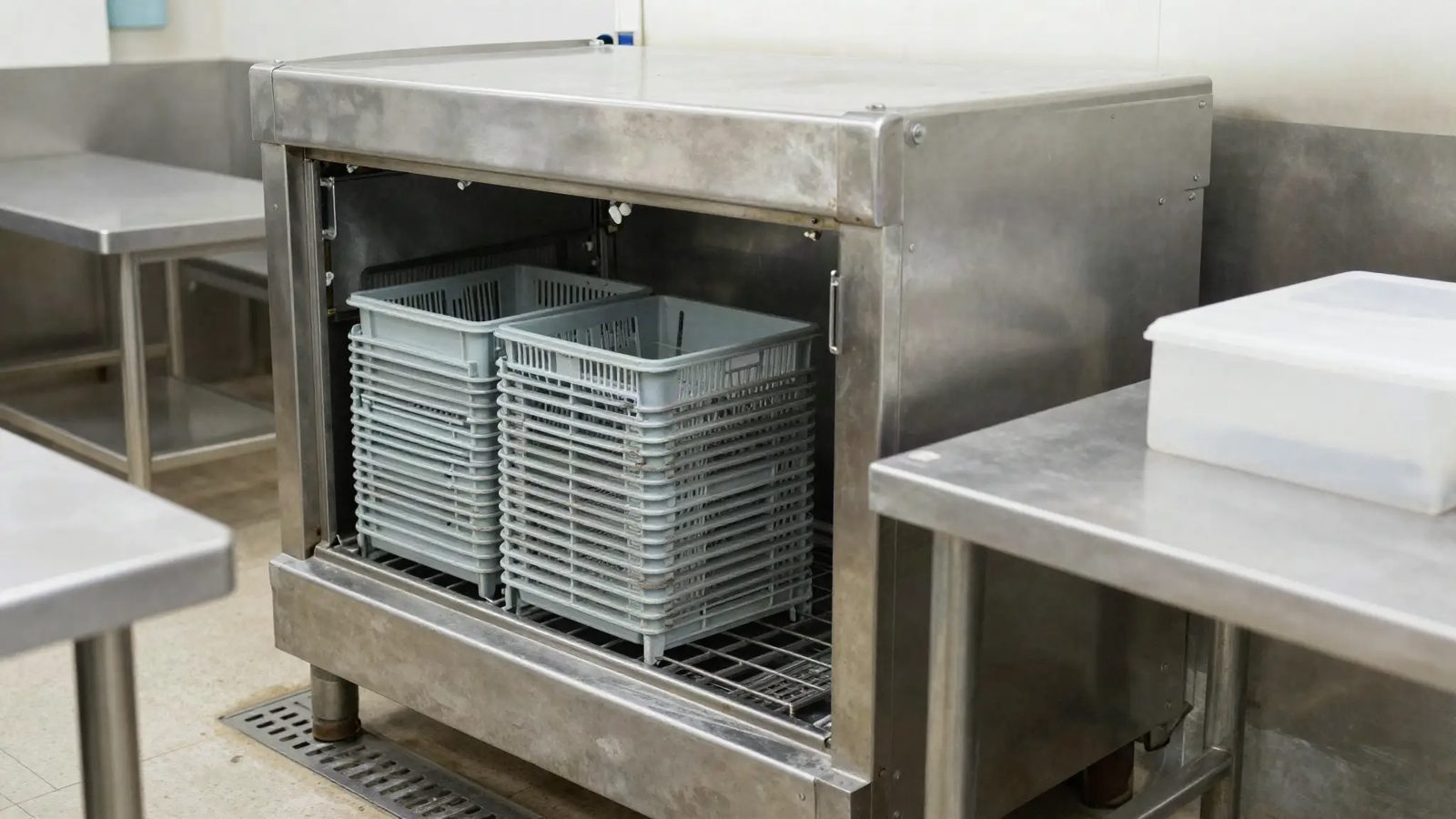
A commercial dish machine sanitizes either with heat or with chemistry. Heat units need a final rinse of 180F, or 165F for stationary rack single temperature units, and chemical units need at least 50 ppm available chlorine. Most faults a technician attends are water problems wearing an equipment costume.
The short version
Two kinds of dish machine sit in commercial kitchens, and they fail differently because they sanitize differently.
A high temperature unit uses heat, usually with a booster heater, and its proof is a temperature. Under NSF/ANSI 3, the standard commercial units are certified to, the final rinse target is 180F for most commercial style units and 165F for stationary rack single temperature models, with a 5 log reduction of bacteria.
A low temperature unit uses chemistry and runs cooler, with wash and rinse around 120F, and its proof is a concentration: at least 50 ppm available chlorine in the final rinse.
Knowing which one you are standing in front of decides what you measure before you open anything.
High temperature or chemical, and what each one demands
| High temperature | Chemical, low temperature | |
|---|---|---|
| What sanitizes | Heat in the final rinse | Chlorine in the final rinse |
| The number to prove | 180F final rinse, 165F for stationary rack single temperature units | 50 ppm available chlorine minimum |
| How it is verified on site | Maximum registering thermometer or temperature sensitive tape | An approved test kit for sanitizer strength |
| Typical running cost | Energy to heat the water | Chemical bought continuously |
| Suits | Heavier soils such as egg and cheese | Lighter soils |
Local code is adopted state by state and can be stricter than the numbers above, so the authority with jurisdiction decides the final answer for a given kitchen.
Why most faults are water faults
Everything a dish machine does depends on water arriving at the right temperature, the right pressure and the right hardness. Change any of those and the symptom appears somewhere else.
| What the kitchen reports | What it often is | Check before parts |
|---|---|---|
| Glasses come out cloudy | Hard water film or etching, not a wash fault | Water hardness, detergent concentration, rinse aid |
| Dishes come out wet | Final rinse too cool, so nothing flashes off | Booster heater, incoming temperature, rinse pressure |
| Soil left on the top rack | Blocked wash arms or a low pump | Arm jets, scrap screens, pump intake |
| Test strip reads low on a chemical unit | Dispenser or supply, rarely the unit | Pickup tube, squeeze tube, chemical level, dilution |
| Scale everywhere inside | Untreated hard water over months | Hardness test, deliming interval, treatment at the inlet |
The second row is the one that gets a booster heater replaced when the real problem is upstream. A booster that cannot reach 180F may be undersized, scaled or fed by a supply that is already too cold, and only one of those is solved by a new heater.
Deliming, and why the interval belongs to the site
Lime builds on every heated surface the water touches. On a dish machine that means the tank heater, the booster and the rinse jets, and the first symptom is usually a rinse that no longer reaches temperature.
There is no universal interval. The water decides it, the same way it decides the interval on an ice machine. A kitchen on soft municipal water and a kitchen on hard well water run the same equipment to completely different schedules.
What makes that manageable is recording the hardness once, then recording each delime against the unit, so the gap between visits is a measured number rather than a habit.
What to leave behind after a service visit
A dish machine is one of the few pieces of equipment where the health inspector checks the same thing the technician checked. Leaving the evidence behind is part of the job.
- The reading, not the verdict: final rinse temperature or chlorine concentration, written down with the date
- Which mode the unit is in: heat or chemical, since a converted unit confuses everybody later
- Water hardness if tested: the number that sets the deliming interval
- What was delimed and when: tank, booster, jets
- What the kitchen has to do daily: scrap screens, tank drain, test strips
Those five live on the equipment record rather than in a technician's notes, because the next visit is often a different technician and the inspection is always a different person.
Roopairs runs a product tour where you can see equipment records, service history per asset and the documentation a visit leaves behind in one place.
What service companies in the trade say
“As a foodservice technician who's been using this type of software daily for over 17 years and has used different software in that time I've got to say Roopairs has nailed it. If you run a small to medium sized foodservice repair company you need to check them out!” — Rich Ortega
Also worth reading
- Commercial Ice Machines: Why They Fail
- Commercial Refrigeration Maintenance Contracts
- Equipment Records for Leased and Customer-Owned Equipment
Frequently asked questions
What temperature does a commercial dishwasher need for the final rinse?
Under NSF/ANSI 3, the final rinse target is 180F for most commercial style units and 165F for stationary rack single temperature models, with hot water sanitizing modes also specifying a minimum wash temperature around 150F. Local code can be stricter.
What chlorine level does a low temperature dishwasher need?
At least 50 ppm available chlorine in the final rinse, verified with an approved test kit. Low temperature units typically run wash and rinse around 120F, which is why the chemistry rather than the heat is doing the sanitizing.
High temperature or low temperature, which is better?
Neither in general. High temperature units cost more to buy and use energy to heat water, and they handle heavier soils such as egg and cheese. Low temperature units cost less up front and buy chemical continuously, and they suit lighter soils.
Why do glasses come out cloudy?
Usually water rather than the wash cycle. A film from hard water wipes off and etching does not, which is the quickest test on site. Check hardness, detergent concentration and rinse aid before suspecting the pump or the arms.
Why are dishes still wet at the end of the cycle?
The final rinse is not hot enough for the water to flash off. Look upstream before replacing the booster heater: incoming supply temperature, scale on the heating element, and rinse pressure all produce the same symptom.
How often should a dish machine be delimed?
As often as the water requires, which is a site number rather than a schedule. Test hardness once, record each deliming against the unit, and let the measured gap between service visits set the interval instead of a habit carried over from another customer.
See how Roopairs can help your service business scale
The all-in-one platform built for commercial kitchen service companies. Dispatch, invoicing, parts ordering — all in one place.
Book a product tour →